

Most home robots today have one thing in common: they’re loud, rigid, and unmistakably robotic. Whether it’s a vacuum cleaner bumping into furniture or a drone buzzing overhead, they’re built to perform tasks – not necessarily to make people feel comfortable. Researchers in Japan think there’s a better way, and it starts with taking inspiration from animated creatures rather than industrial machines.
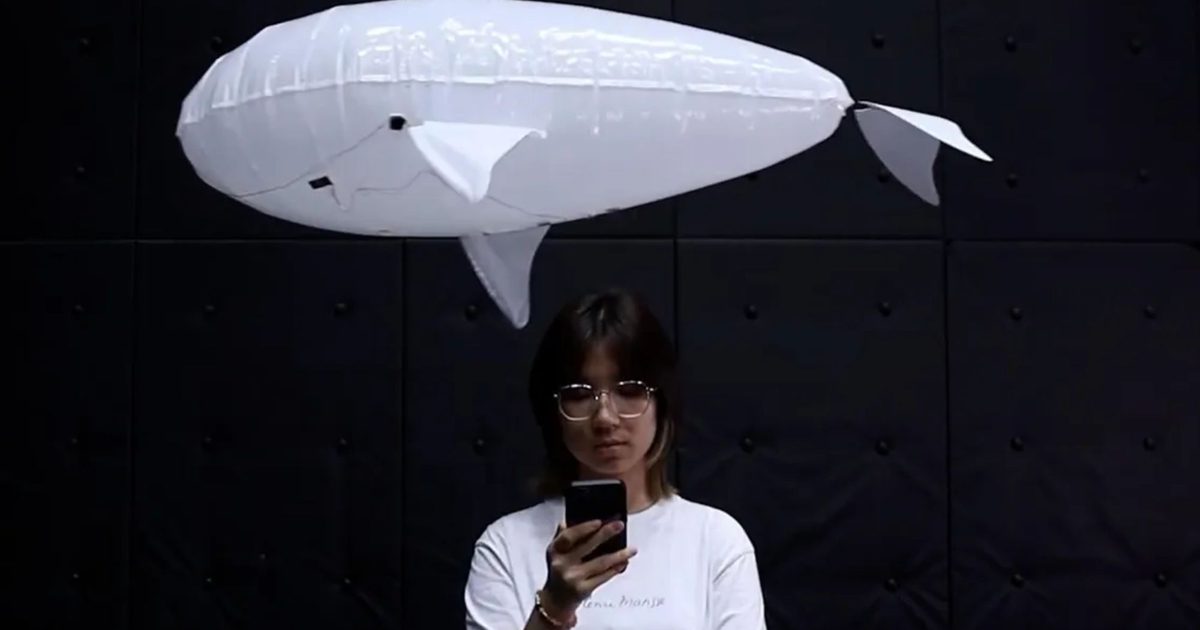
A research team led by Mingyang Xu at Keio University, in collaboration with institutions including the MIT Media Lab, has unveiled a prototype floating companion robot that glides silently through the air instead of rolling across the floor. Rather than looking like another gadget, the robot resembles a tiny floating creature, drawing inspiration from characters such as Tinker Bell, Pokémon’s Mew, and Studio Ghibli’s Soot Sprites. These whimsical influences are intentional: the goal is to create a robot that feels like a living, breathing companion rather than a cold machine.
The team recently demonstrated the concept in a video showcasing how these lighter-than-air robots could one day become part of everyday life. In the footage, the robot drifts gently from room to room, interacting with people in a way that is both playful and calming. The design philosophy here is radical: instead of optimizing for speed, efficiency, or utilitarian function, the robot prioritizes emotional resonance and human comfort.
A softer approach to robots that live alongside humans
Unlike conventional drones, the prototype doesn’t rely on fast-spinning propellers that produce constant noise. Instead, it uses a lighter-than-air design with small fins that gently propel it through the air, giving it the appearance of a floating white whale drifting from room to room. The absence of sharp edges, hard shells, or exposed mechanisms makes it inherently safer for close-proximity interaction. There are no pinch points, no rapidly moving blades that could cause injury. This is a robot designed to coexist with humans in the same physical space, not to be separated by barriers or operated only when the room is empty.
The design isn’t simply about aesthetics. Because the robot is lightweight, soft-bodied, and lacks exposed moving parts or pinch points, it can safely interact with people without posing the same risks as traditional flying robots. That opens up possibilities for robots that don’t need to stay behind safety barriers or operate only when humans aren’t nearby. In the demonstration, the floating companion performs surprisingly ordinary tasks. It wakes users up like an alarm clock, delivers reminders, keeps someone company while studying, dances alongside its owner, and even serves as a playful source of entertainment. Rather than replacing smartphones or smart speakers, the robot acts more like a friendly presence that naturally shares the same physical space as its owner.
This approach represents a significant shift in robotics philosophy. For decades, the field has been dominated by the pursuit of human-like robots that can perform complex tasks with precision. But that pursuit often comes at the cost of approachability. Industrial robots are intimidating; even many consumer robots are designed with a utilitarian aesthetic that prioritizes function over form. The Cuddle-Fish project flips that script, suggesting that the most successful home robot might be one that feels less like a tool and more like a pet.
Why making robots feel approachable matters
The project also tackles one of robotics’ oldest design problems: the uncanny valley. Researchers have long found that robots designed to look almost human often make people uncomfortable because their appearance falls somewhere between familiar and artificial, leading to instances involving the uncanny valley – an effect where someone feels something looks almost human, but not quite there. This phenomenon has plagued efforts to create humanoid companions for decades. Even the most advanced androids, with their silicone skin and mechanical eyes, often trigger a sense of unease in those who interact with them.
Instead of trying to build realistic facial expressions, the research team believes emotion can be communicated through movement itself. Gentle floating motions, soft body language, and playful interactions may prove more effective than synthetic smiles or blinking digital eyes. This idea is not entirely new – it draws on principles of animation and character design that have been used in film for nearly a century. By borrowing from the language of animation, the robot can express excitement, curiosity, or calm through its motion patterns alone, without needing a face or voice.
The philosophy here is deeply human. We read intent and emotion into the movements of animals and even inanimate objects all the time – a leaf fluttering in the wind can feel melancholy, a ball bouncing down stairs can feel joyful. The same principle applies to robots. By designing for motion-based expression, the researchers are tapping into a fundamental aspect of how we perceive the world.
Technical details and challenges
Under the hood, the robot achieves its buoyancy through the use of a lighter-than-air gas, likely helium, contained within a soft, flexible envelope. The fins are actuated by small, quiet motors that adjust the robot’s direction and speed. The entire system is designed to be as energy-efficient as possible, allowing it to operate for extended periods without recharging. However, the prototype is still far from being a commercial product. Challenges remain in terms of stability, control, and battery life. The robot must be able to navigate complex indoor environments without bumping into obstacles, and it must do so in a way that feels natural and unobtrusive.
Another challenge is ensuring that the robot can respond to human interaction in real time. The current version relies on a combination of sensors and pre-programmed behaviors, but future iterations could incorporate AI that learns from its environment and adapts its behavior to the preferences of its owner. This would allow the robot to become more personalized over time, knowing when to be playful and when to be quiet.
The project is a collaboration between several institutions, including Keio University and the MIT Media Lab, which has a long history of exploring unconventional robotic designs. The Media Lab’s Biomechatronics group, for example, has developed soft robotic actuators and flexible sensors that could be integrated into future versions of the Cuddle-Fish. This cross-institutional collaboration is crucial because it brings together expertise from different fields – robotics, materials science, animation, and human-computer interaction.
The broader context: AI companions and the future of home robotics
That philosophy could become increasingly important as AI companions become more common. Companies such as OpenAI, Meta, and Apple are investing heavily in AI assistants that are expected to move beyond smartphones and into dedicated hardware. At the same time, robotics companies are racing to build home companions that people actually enjoy living with – not just machines that complete chores. The success of devices like Amazon Astro, which combines a mobile screen with a wheeled base, shows that there is consumer appetite for robots that accompany rather than just perform tasks. But Astro is still fundamentally a machine on wheels; the Cuddle-Fish aims to take that concept a step further by removing the mechanical feeling entirely.
The trend toward emotionally engaging robots is not limited to this one prototype. In recent years, we have seen the rise of robotic pets like Sony’s Aibo and various therapeutic robots designed for elderly care. These devices have shown that people form genuine emotional bonds with robots that display even rudimentary social behaviors. The Cuddle-Fish extends that logic into the aerial domain, where the potential for graceful, cinematic movement is even greater.
This floating robot isn’t close to becoming a commercial product yet, but it offers an intriguing glimpse of what the next generation of AI companions might look like. If researchers are right, the most successful home robot of the future may not resemble a humanoid assistant at all. It might simply drift quietly into the room like something straight out of an animated fantasy film.
Source: Digital Trends News