

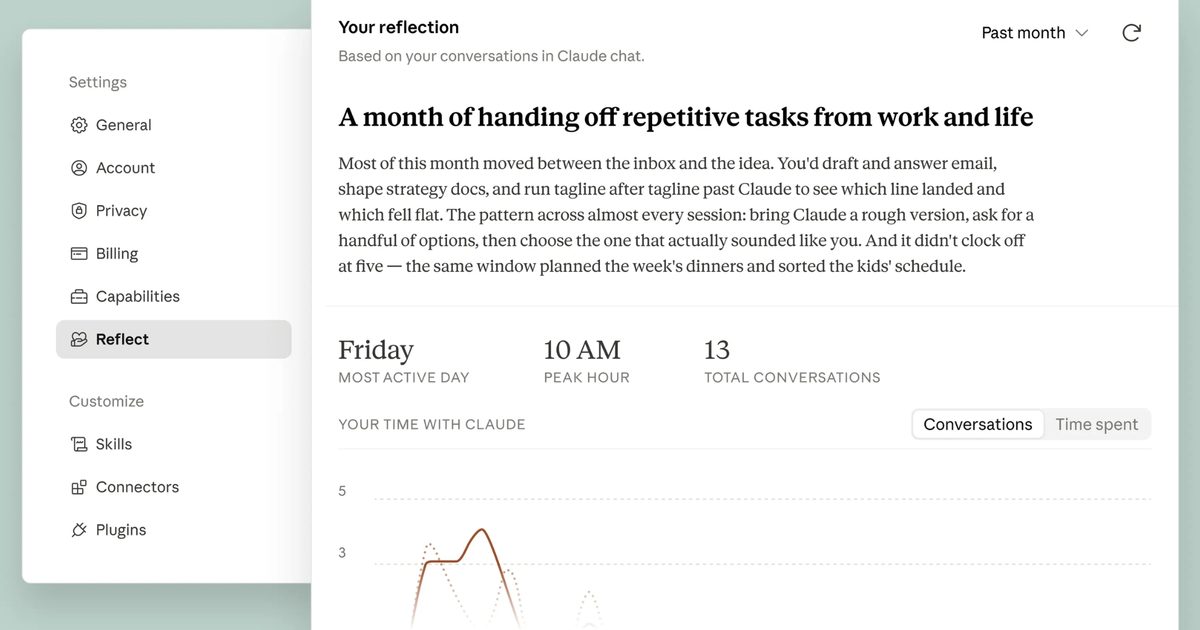
Anthropic has introduced Claude Reflect, a new usage analytics dashboard designed to help users better understand and reflect on their interactions with the Claude AI assistant. Available in beta for free, Pro, and Max users who have enabled memory, the feature goes beyond simple statistics to encourage more mindful engagement with artificial intelligence.
In an era where AI tools are increasingly integrated into daily workflows, the concept of tracking and reflecting on usage patterns has become more relevant than ever. Similar to the year-end 'Wrapped' features popularized by streaming services like Spotify and music platforms, Claude Reflect provides users with a comprehensive overview of their AI activity. However, instead of focusing on listening habits or gaming statistics, this dashboard delves into the nuances of human-AI collaboration.
What Claude Reflect Reveals
Accessible through the Settings menu in Claude's web and desktop applications, Reflect allows users to generate summaries of their interaction data for periods of one, three, six, or twelve months. The dashboard breaks down the topics users engage with most frequently, identifies recurring patterns in their queries, and categorizes interactions using Anthropic's proprietary 4D AI Fluency Framework. This framework classifies AI usage into four distinct dimensions: delegation, description, discernment, and diligence.
Delegation refers to tasks where users ask Claude to perform actions on their behalf, such as drafting emails or generating reports. Description involves queries where users seek explanations or clarifications about concepts. Discernment captures instances where users ask Claude to evaluate or compare options, while diligence reflects interactions where the AI assists in detailed problem-solving or research. By organizing interactions into these categories, Claude Reflect provides users with a structured understanding of how they leverage AI capabilities, rather than merely presenting raw conversation counts or topic frequencies.
Privacy and Data Handling
Anthropic has emphasized that the data displayed in Reflect is handled with user privacy in mind. Incognito conversations and those involving health integrations are explicitly excluded from the dashboard. The company states that the information remains within the dashboard and is not used for any other purposes, such as model training or advertising. This approach aligns with growing consumer expectations around transparency and data control in AI tools.
The development of Claude Reflect involved collaborations with several prominent organizations focused on digital well-being, including the MIT Media Lab, the Digital Wellness Lab at Boston Children's Hospital, and the Family Online Safety Institute. These partnerships underscore Anthropic's commitment to integrating ethical considerations into product design, particularly regarding the potential for excessive AI reliance.
The Wellness Angle
What sets Claude Reflect apart from similar analytics tools is its explicit focus on encouraging healthier technology habits. The dashboard surfaces thought-provoking questions such as: “What’s one thing you want to keep doing yourself, even if Claude could do it faster?” This prompt challenges users to consider the boundaries of AI delegation and the value of preserving human effort in certain tasks.
Users can also set quiet hours, during which they receive fewer or no notifications from Claude, and schedule nudges that remind them to take breaks from interacting with the AI. These features are designed to mitigate the risk of overreliance on AI and promote a more balanced approach to digital tool usage. A time-spent view is planned for future release, which will track the duration of user interactions with Claude, offering even deeper insights into engagement patterns.
An AI company actively encouraging users to rely less on its own product is a rare and noteworthy development. This approach reflects Anthropic's broader philosophy of building AI systems that augment human capabilities without diminishing human agency. By providing tools that help users understand and regulate their usage, the company positions itself as a leader in responsible AI development.
Broader Context and Implications
The launch of Claude Reflect comes at a time when concerns about AI addiction and overuse are gaining traction. Studies have shown that excessive interaction with AI chatbots can lead to reduced critical thinking skills and increased dependency on automated assistance. Features like Reflect, which promote self-reflection and intentional usage, could play a crucial role in mitigating these risks.
Moreover, the dashboard serves as a valuable resource for researchers and policymakers studying human-AI interaction patterns. By aggregating anonymized data on how users engage with different types of tasks, Anthropic could contribute to a better understanding of the evolving relationship between humans and AI. The company has not indicated whether aggregate data will be made available for research, but the collaboration with academic institutions like MIT Media Lab suggests a willingness to engage with the broader scientific community.
For individual users, Claude Reflect offers an opportunity to optimize their use of AI. By identifying which topics consume most of their interactions or which framework dimensions are over- or underutilized, users can adjust their behavior to achieve more efficient outcomes. For example, a user who delegates excessively might benefit from spending more time on discerning activities, such as evaluating AI-generated outputs for accuracy and bias.
The feature is currently in beta, meaning Anthropic is likely to refine it based on user feedback. The addition of a time-spent view will further enhance its utility, providing a quantitative measure of engagement that complements the qualitative insights already available. As AI becomes more embedded in everyday life, tools like Claude Reflect will become essential for maintaining a healthy equilibrium between technological assistance and human effort.
Source: Digital Trends News