

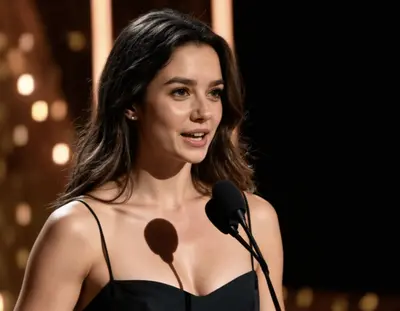
Virtual actress Tilly Norwood, a digital creation that first debuted in the autumn of 2025, has remained largely inactive in the film industry since her launch. That is about to change. On Monday, her creators at the studio Particle6 announced that they will produce a feature-length film specifically for her to star in. The movie, titled 'Misaligned', will be generated entirely using artificial intelligence, though it will rely heavily on human writers, technicians, and actors to bring the story to life.
Particle6 CEO and founder Eline van der Velden emphasized the collaborative nature of the project. 'AI can support premium narrative filmmaking, but only with substantial amounts of human craft, skill, judgement and time,' van der Velden stated. 'That's not a limitation of the technology. That's the point.' She added that the filmmakers who will thrive in the coming decade are those who bring decades of storytelling instinct to these new tools, and that 'Misaligned' represents the studio's effort to put that philosophy to work at a feature scale.
The film's title is a direct reference to the concept of AI alignment—the challenge of ensuring that artificial intelligence systems understand and pursue human values and goals. The story reportedly revolves around a virtual character struggling to reconcile its programmed objectives with the unpredictable, nuanced demands of human society. While the plot details remain under wraps, the thematic focus underscores the broader ethical and technical conversations surrounding advanced AI.
The Rise of Tilly Norwood
Tilly Norwood was introduced as a photorealistic virtual influencer in late 2025, joining a growing roster of digital personalities that had already populated social media platforms for years. Unlike her predecessors, who often focused on brand endorsements and lifestyle content, Norwood was specifically marketed as an actress. However, despite initial buzz, no studio or production company had cast her in a film—until now.
The wait may have been strategic. Particle6 used the intervening period to refine the technology behind Norwood, improving her expressiveness and ability to interact with human actors on set. Van der Velden noted that the development of 'Misaligned' has been in the works for months, with a team of human screenwriters crafting the script while AI handled the rendering, voice synthesis, and dynamic character animation.
The studio's approach mirrors that of other AI-native production companies, but with a greater emphasis on human oversight. According to sources familiar with the project, every scene in 'Misaligned' undergoes review by a human director and editor before finalization. This hybrid workflow is designed to preserve narrative coherence and emotional depth—areas where current generative AI tools often struggle.
Hollywood's Uneasy Relationship with AI
The announcement of 'Misaligned' comes at a tense moment for the entertainment industry. Major Hollywood unions, including SAG-AFTRA and the Writers Guild of America, have been vocal about the need to regulate the use of AI in creative work. Leading actors such as Scarlett Johansson and Cate Blanchett have publicly called for stricter limits on the employment of generative AI tools on copyrighted artistic material without explicit permission.
The concern is twofold: first, that AI could displace human actors and writers, particularly in background roles or for generating dialogue; and second, that AI models trained on existing copyrighted works could infringe upon intellectual property rights. The 2023 strikes by writers and actors already brought these issues to the forefront, and the rapid advancement of AI since then has only intensified the debate.
Particle6's van der Velden has positioned the studio as a proponent of ethical AI use. She insists that 'Misaligned' is not an attempt to replace human talent but rather to augment it. The film's cast includes human actors who perform alongside Norwood, with AI used primarily for the lead character and for certain visual effects. The studio has also committed to crediting all human contributors and paying standard industry rates.
A Brief History of Virtual Actors
The concept of digital actors is not new. From the early days of computer-generated imagery (CGI) in films like 'Jurassic Park' and 'Final Fantasy: The Spirits Within', to the more recent resurrection of deceased performers using deepfake technology, the industry has long explored the boundaries between real and synthetic performance. Tilly Norwood belongs to a newer category: the virtual influencer or actor that exists primarily online and is designed to engage with audiences in real-time.
Other notable examples include Lil Miquela, a digital influencer with millions of followers on Instagram; and the virtual singer Hatsune Miku, who has performed in concerts around the world. However, none of these figures have yet led a feature-length narrative film. Norwood's 'Misaligned' could thus be a landmark moment, proving whether a fully AI-generated character can carry a story over the course of 90 minutes or more.
The technical challenges are considerable. To create a believable performance, the AI must not only generate realistic facial expressions and body language but also deliver dialogue with appropriate tone, timing, and emotional nuance. Recent advances in large language models (LLMs) and text-to-video generation have made this more feasible, but critics argue that the results still lack the spontaneity and depth of a human actor.
The Technical Pipeline
Particle6 has not disclosed the full technical stack behind 'Misaligned', but industry analysts speculate that the production uses a combination of generative adversarial networks (GANs) for image creation, and transformer-based models for script-to-video synthesis. The human writers provide the narrative framework and key dialogue, while the AI fills in the visual and vocal details.
One innovative aspect may be the use of real-time rendering, allowing the director to see the AI-generated character perform alongside human actors during filming. This could streamline the production process and reduce the need for extensive post-production. However, it also requires significant computing power and careful calibration to avoid the uncanny valley effect—the phenomenon where a near-human representation causes discomfort in viewers.
Van der Velden has acknowledged that 'Misaligned' is an experimental project. 'We are learning as we go,' she said in a press briefing. 'Every day brings new insights about how AI can support storytelling. But we are also learning about its limitations. The technology is not ready to replace human creativity; it is a tool, and like any tool, it requires skilled hands to wield it effectively.'
Distribution and Release
As of now, no distribution deal has been announced for 'Misaligned'. A spokesperson for Particle6 told reporters that it is too early to discuss whether the film will appear in theaters, on streaming platforms, or through a direct-to-digital release. The timeline is also uncertain, though the studio hopes to have a rough cut ready by early 2027.
The lack of a distributor could be a significant hurdle. Major studios and streaming services have been cautious about acquiring AI-generated content, wary of both technical quality and potential backlash from unions and audiences. Some independent distributors, however, have expressed interest, seeing 'Misaligned' as a potential novelty that could attract curious viewers.
Particle6 is exploring alternative distribution models, including a possible limited theatrical release followed by a streaming premiere on a platform that specializes in avant-garde or tech-focused content. The studio is also in talks with film festivals, aiming to premiere 'Misaligned' at a major event such as Sundance or SXSW, where technology-driven projects often receive a warm reception.
Broader Implications
The success or failure of 'Misaligned' could have lasting effects on how the film industry perceives AI. If the film is critically and commercially successful, it may encourage other studios to invest in similar projects, potentially accelerating the adoption of AI tools in creative workflows. Conversely, if it fails to resonate with audiences, it could reinforce skepticism and lead to stricter regulatory measures.
Ethical questions also remain unresolved. Should digital actors like Tilly Norwood have any form of rights or protections? Who owns the copyright to a performance generated by AI? These issues are being debated in legal circles, but no clear consensus has emerged. The industry is watching closely, and 'Misaligned' may become a test case for future policy decisions.
Meanwhile, human actors and writers continue to adapt. Many are learning to incorporate AI into their own workflows, using it for brainstorming, storyboarding, or even generating rough drafts of dialogue. The line between human and machine collaboration is blurring, and 'Misaligned' is at the forefront of that change.
Source: Jacaranda FM News