

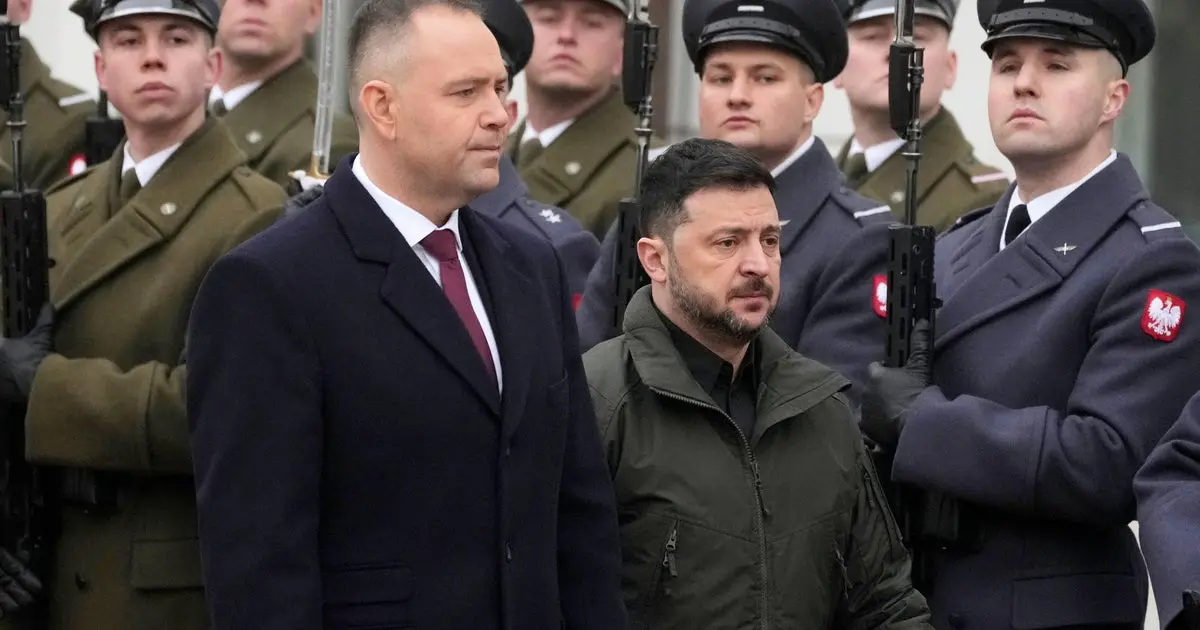
Ukrainian President Volodymyr Zelenskyy has returned Poland's highest state honor, the Order of the White Eagle, after Polish President Karol Nawrocki revoked the award in a politically charged dispute over World War II history. The move marks a significant deterioration in relations between the two neighboring countries, which have been close allies since Russia's full-scale invasion of Ukraine in 2022.
Zelenskyy announced his decision on social media, stating that he believed the order "was meant for the Ukrainian People and our army." He posted photographs of the order and a postal receipt, indicating he had mailed it back to the Polish presidential office. "I sent the Order back to the President of Poland. I believe the future will confirm the respect Ukrainians deserve," he wrote.
The controversy began when Zelenskyy issued a decree on May 26 naming a unit of Ukraine's Special Operations Forces after the Ukrainian Insurgent Army (UPA). The UPA operated during the 1940s and 1950s, fighting for Ukrainian independence against both Nazi Germany and Soviet forces. However, the organization has been accused by Poland of orchestrating the mass killings of tens of thousands of Poles, particularly in the regions of Volhynia and Eastern Galicia during World War II. In 2016, the Polish Parliament recognized these crimes as genocide.
Nawrocki, a nationalist politician, delivered a 13-minute address on social media explaining his decision to revoke the honor. "For the majority of Polish society, the Ukrainian Insurgent Army remains above all a formation responsible for cruel crimes against the citizens of the Polish Republic during World War II," he said. He asserted that the revocation did not mean Poland's support for Ukraine in its defense against Russia would decrease.
The original award was bestowed upon Zelenskyy in 2023 by former Polish President Andrzej Duda for services to security, resilience, and the defense of human rights. At that time, Poland was one of Ukraine's most steadfast supporters, hosting millions of Ukrainian refugees and providing substantial military aid. However, the relationship has been increasingly strained by historical grievances and domestic political pressures within Poland.
Nawrocki's decision has been condemned by Ukrainian officials. Kyrylo Budanov, head of the Ukrainian Presidential Office, called it "an unfriendly act toward our people" and "a gift to the Moscow aggressor, which will certainly use it against both of our countries." Four Ukrainian officials, including Budanov, said they would return state honors that Poland had issued them.
But some Ukrainian voices criticized Zelenskyy's response. Former Prime Minister Arseniy Yatsenyuk wrote on X that one "harmful and incorrect decision by the current president of Poland cannot be corrected by other incorrect decisions of ours." This reflects a division within Ukraine over how to handle the dispute.
The row comes at a delicate time. Poland is scheduled to host a major event on Ukraine's postwar reconstruction next week, which Zelenskyy was expected to attend. The dispute could overshadow the gathering and potentially affect international confidence in Ukraine's reconstruction efforts.
Historical Context of the UPA and Polish-Ukrainian Relations
To understand the depth of the conflict, it is essential to examine the history of the Ukrainian Insurgent Army and the broader Polish-Ukrainian relationship. The UPA was formed in 1942 as the military wing of the Organization of Ukrainian Nationalists (OUN). Its goal was to establish an independent Ukrainian state. During World War II, the UPA fought against both the Nazi occupation and the Soviet Red Army. However, its legacy is marred by accusations of ethnic cleansing against Poles in Volhynia and Eastern Galicia between 1943 and 1944.
Polish historians estimate that between 60,000 and 120,000 Poles were killed by UPA forces in brutal campaigns that involved massacres, forced displacement, and destruction of villages. The Ukrainian side argues that many Ukrainians were also killed by Polish underground forces, and that the conflict was a tragic result of intertwined nationalist movements and wartime chaos. The memory of these events remains deeply painful for many Poles, and the UPA is widely viewed in Poland as a criminal organization.
In contrast, within Ukraine, the UPA is often celebrated as a symbol of the struggle for independence, particularly in western Ukraine. Some Ukrainian nationalists honor UPA fighters as heroes, a view that has gained traction since Russia's annexation of Crimea in 2014 and the subsequent war in Donbas. The Ukrainian government has sought to rehabilitate the legacy of the OUN and UPA, passing laws that recognize their struggle as part of Ukraine's fight for sovereignty.
This divergence in historical memory has long been a source of tension between Kyiv and Warsaw. Efforts at reconciliation have been ongoing, including discussions about exhumation of Polish victims. A December meeting between Zelenskyy and Nawrocki in Warsaw had signaled progress on historical reconciliation. However, the recent decree naming a special forces unit after the UPA has undone much of that goodwill.
Political Calculations in Poland and Ukraine
President Karol Nawrocki is a nationalist politician who has exploited anti-Ukrainian sentiment for electoral gain. His decision to revoke the Order of the White Eagle should be seen in the context of Poland's internal politics. Nawrocki is positioning himself as a defender of Polish national memory against what he portrays as Ukrainian revisionism. This resonates with a segment of Polish society that remains skeptical of Ukraine, despite the overwhelming public support for aiding Ukraine against Russia.
Ukrainian President Volodymyr Zelenskyy, on the other hand, faces his own domestic pressures. Naming a military unit after the UPA appeals to nationalist constituencies within Ukraine, especially in the west, where the UPA is revered. It also serves to underscore Ukraine's long history of resistance against both Nazi and Soviet aggression, a narrative that aligns with the current war effort against Russia. Zelenskyy's decision to return the Polish honor is likely an attempt to frame the dispute as a matter of principle: that the honor was given to the Ukrainian people, not to him personally.
The reaction from Polish Prime Minister Donald Tusk, a political rival of Nawrocki, highlights the complexity. Tusk urged both leaders to "tone down emotions, not stoke tensions," and warned that the row "delights Putin and shocks our allies." Tusk's government has been a key supporter of Ukraine, but Nawrocki's actions could undermine that support, especially as Poland approaches its own elections. The dispute demonstrates how historical wounds can be weaponized in contemporary politics.
Implications for Ukraine's Western Support
Poland has been one of Ukraine's most important allies during Russia's war. It has served as a hub for Western military aid, hosted over 1.5 million Ukrainian refugees, and provided billions of dollars in assistance. Any strain in this relationship could have serious consequences for Ukraine's ability to sustain its defense. While Nawrocki insists that support will continue, the diplomatic row risks creating uncertainty among other Western partners. If Poland, a frontline NATO state, is seen as wavering in its solidarity, it could embolden Russia and encourage other allies to reassess their commitments.
Moreover, the dispute comes at a time when Ukraine is facing battlefield challenges and needs continued Western unity. The Russian government is likely to exploit the rift, using it to undermine the narrative of a unified West. Zelenskyy's attempt to frame the issue as a matter of respect for the Ukrainian people may be an effort to maintain public sympathy in Poland, where many ordinary Poles still support Ukraine. However, the emotional resonance of the UPA massacres is hard to overcome.
The Volhynia massacres of 1943-1944 remain a raw wound in Polish memory. In villages across what is now western Ukraine, UPA fighters systematically killed Polish civilians, often with extreme brutality. Entire families were wiped out, and thousands fled their homes. The Polish government has long sought full exhumation and proper burial of the victims, a process that has been slow due to political sensitivities in Ukraine. Some progress was made in 2024, with agreements to allow Polish teams to search for remains, but the UPA decree has stalled that cooperation.
On the Ukrainian side, the UPA is also remembered for its resistance against Soviet repression after the war. Many Ukrainian families have ancestors who fought in the UPA, and the organization is seen as a precursor to today's Ukrainian armed forces. The naming of a modern special operations unit after the UPA is part of a broader trend in Ukraine of reclaiming historical figures and groups that were once vilified under Soviet rule. This includes renaming streets, erecting monuments, and incorporating symbols into military insignia.
The diplomatic fallout from the decree has also affected ordinary Ukrainians living in Poland. About 1.5 million Ukrainian refugees currently reside in Poland, and many have faced increasing prejudice despite their contributions to the Polish economy. Friction over historical issues can exacerbate xenophobia, although Polish civil society groups continue to provide support. The Ukrainian community in Poland has expressed concern that the dispute could lead to a backlash against them.
Looking ahead, both sides face difficult choices. Polish President Nawrocki has doubled down on his decision, claiming it was a necessary defense of Polish honor. Zelenskyy, by returning the order, has drawn a line but left the door open for future reconciliation. Polish Prime Minister Tusk is trying to mediate, but his influence is limited as Nawrocki holds the presidency independently of Tusk's government. The European Union has remained largely silent, though some diplomats have privately expressed concern about the rift weakening the anti-Russian coalition.
The reconstruction conference in Poland next week will be a key test. If Zelenskyy attends, it could signal a willingness to move past the dispute. If he stays away, it will deepen the crisis. Meanwhile, Russia is likely to amplify the story, using it as propaganda to show that Western unity is fragile. For now, the future of Polish-Ukrainian relations hinges on whether both leaders can separate historical grievances from the urgent need to counter a common enemy.
Source: Cbsnews News