

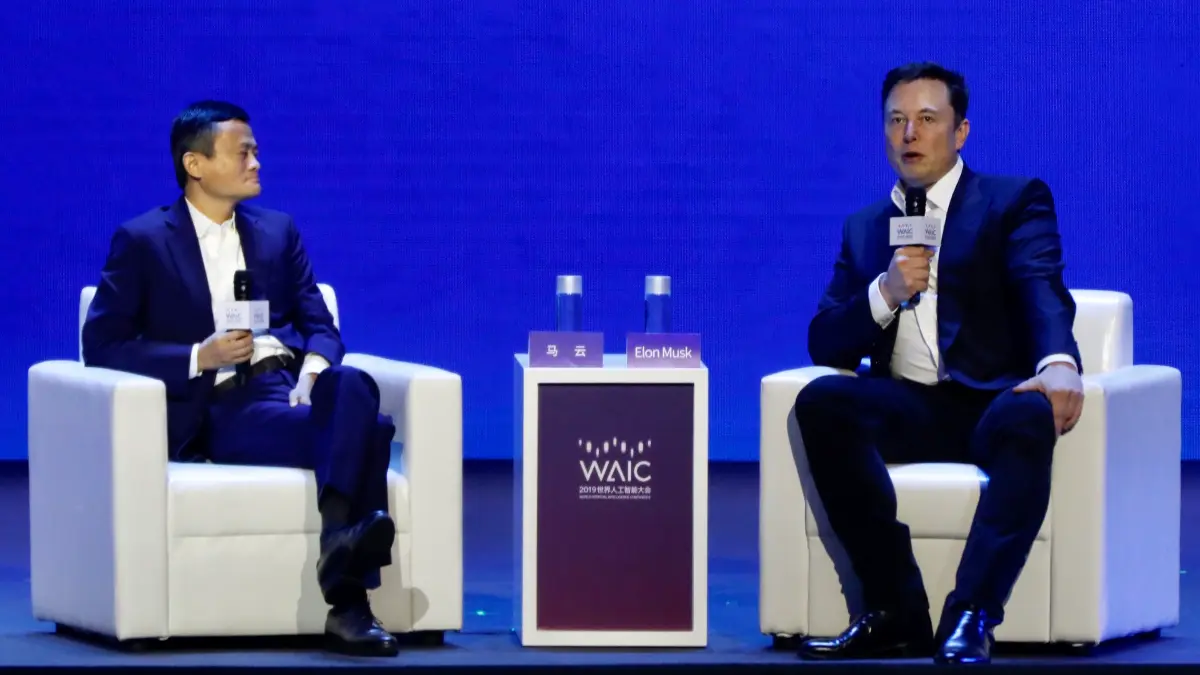
It wasn't quite a 'battle of the billionaires' brains,' but Jack Ma and Elon Musk made for an interesting pair at a Shanghai event together. Sitting next to Jack Ma, executive chairman of Alibaba, Elon Musk talked about SpaceX's plans to visit Mars. And then he went into full stoner mode.
'I think it’s important for us to take the set of actions that are most likely to continue consciousness into the future,' he said. 'I think we should not take it for granted that consciousness will continue because we have not encountered any aliens.'
It got better: 'Where are the aliens? This is the Fermi Paradox. This is one of the most important questions: How come we have not found any aliens? There are people out there who think that we’ve found aliens. Trust me, I would know, we have not.'
That was just part of a weird and sometimes wonderful 'debate' between the two billionaires in Shanghai, where they pontificated on jobs, education, and, mostly, argued about the future humans face with artificial intelligence.
The Fermi Paradox and the Fate of Consciousness
Musk's reference to the Fermi Paradox—the apparent contradiction between the high probability of extraterrestrial life and the lack of evidence for it—was not casual. He has often cited this paradox as a reason to be cautious about humanity's future. In his view, if intelligent civilizations are common in the universe, why haven't we detected any signals? The silence could imply that advanced civilizations tend to self-destruct before becoming interstellar. Musk used this to argue that humanity must become a multi-planet species quickly, to avoid a similar fate.
'Assuming a benign scenario with AI, we will just be too slow,' he said. 'Human speech to a computer will sound like very slow tonal wheezing, kind of like whale sounds.' Musk considers humans already 'cyborgs' due to our reliance on phones and computers, but he believes we are doomed in any attempt to keep up with exponentially advancing AI.
Optimism vs. Alarmism on AI
In contrast, Ma said he was 'quite optimistic' about how AI would benefit humanity. 'I don’t think AI is a threat,' he said. 'I don’t think AI is something terrible.' Musk's response: 'I don’t know, man, that’s like famous last words.' He added that technology's rate of advancement is 'outpacing our ability to understand it.'
This issue came up a bit later when, talking about education, Ma took a humanist approach, saying the focus should be on the arts and growing wisdom: 'A computer is just a toy. A computer has chips, man has heart. The heart is where wisdom comes from.' Musk disagreed, pointing out that humans have already been outsmarted by machines at games like chess and Go. Ma insisted it was 'stupid' to consider this a sign computers were smarter than humans, comparing it to a human trying to out-run a car. Man created the car, but just because he can't run as fast doesn't mean man isn't as smart as a car. 'I’ve never seen a computer invent a human being,' Ma said.
Mars vs. Earth: Two Visions
They also talked at length about Mars. Humanity must become a multi-planet species, Musk insisted, because we are in what he considers a short window to 'secure the future of consciousness such that the light of consciousness is not extinguished' before something happens to Earth—be it something 'external' like a meteor strike or an 'internal unforced error' like climate change. Musk has long championed Mars colonization through SpaceX, aiming for a self-sustaining city of one million people by 2050.
While Musk had visions of Mars, Ma claimed to have his feet firmly on the ground: 'I admire your courage for exploring Mars, but I admire a lot of people who are spending efforts improving Earth.' Ma's focus aligns with Alibaba's initiatives in rural development, environmental sustainability, and poverty alleviation. He believes that solving Earth's problems should come before looking outward.
The Future of Work and the 12-Hour Week
When the topic turned to jobs, Ma said that as advancements helped people live longer and AI took over more jobs, humans would find more time to enjoy being human. In a bit that seemed to expose a billionaire's disconnect from a working class that lives paycheck to paycheck just to keep food on the table, Ma said people should work a 12-hour week (four hours per day, three days a week). This would enable humanity to be happier and enjoy being human beings.
Ma's vision of a shorter workweek is part of his broader philosophy that technology should free humans from drudgery, allowing more time for creativity, arts, and social connections. However, critics note that such a scenario assumes a world where basic income or universal wealth redistribution exists—an idea that remains controversial. Musk did not directly challenge the feasibility of the 12-hour week, instead pivoting back to the existential threats that humanity faces.
The Neuralink Gamble
If the idea of humanity being able to only work 12 hours a week and apparently make enough money to live comfortably seems weird, it was nothing compared to what followed when Musk started talking about Neuralink. He described a brain-computer interface that could 'save your state and restore your state like a saved game.' This technology, he claims, could help humans merge with AI rather than be outpaced by it. Neuralink aims to create a high-bandwidth interface between the human brain and computers, initially for medical applications like treating paralysis, but ultimately for human enhancement.
Ma, for his part, remained skeptical. He agreed that AI could improve sustainability but questioned the need to augment humans directly. 'I think our brain is already powerful enough,' Ma said. The exchange captured the fundamental philosophical difference between the two: Musk sees humans as flawed and limited, in need of technological upgrades to survive a hostile universe; Ma sees humans as essentially wise and capable, with technology as a tool rather than a savior.
The two were clearly more comfortable with the back-and-forth by the end, when Musk talked about using Neuralink as a way to 'save your state and restore your state like a saved game' and Ma agreed about AI's ability to improve sustainability. It was, at times, an enthralling intellectual battle of billionaires. Other times ... not so much. Maybe they should get a moderator for the next debate.
The Shanghai event highlighted the growing divide among tech elites about the path forward. On one side, Musk represents the 'tech solutionist' camp: believe in grand space projects, brain-computer interfaces, and a deep fear of AI apocalypse. On the other, Ma embodies 'humanistic optimism': focus on Earth, trust human creativity, and see AI as a partner, not a rival. As AI continues to evolve and space exploration accelerates, these two visions will continue to clash, shaping the future of technology policy and public perception. For now, the world watches and wonders: will we find aliens, or will we become aliens ourselves?
Source: Mashable News