

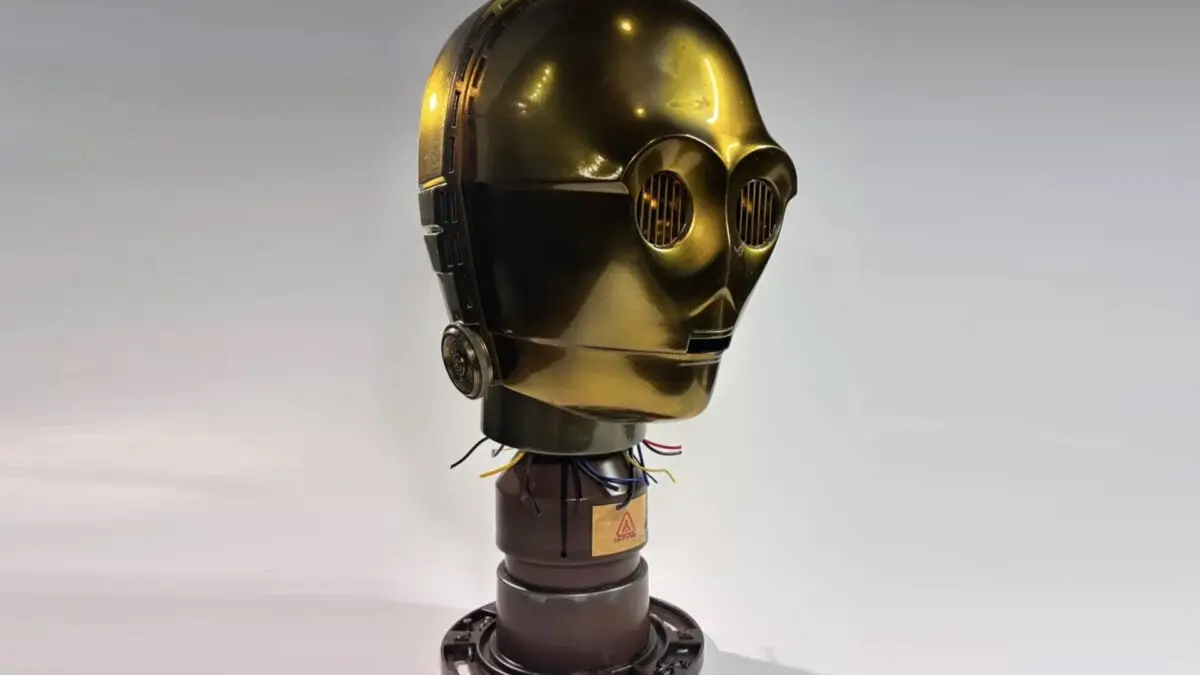
May the fourth be with you, and all that. For Star Wars Day, we’re focusing on one of the galaxy’s most recognizable droids: C-3PO, the shiny golden protocol droid with a personality that blends politeness and exasperation. While R2-D2 often steals the show with his beeps and whistles, C-3PO’s verbose complaints are equally iconic. Now, thanks to a student project, you can build your own talking C-3PO head that actually converses with you—giving you a taste of what it’s like to be R2-D2, constantly on the receiving end of those dramatic outbursts.
The project comes from Samuel Potozkin, a student at Chapman University in Orange County, California. He recently posted a video detailing how he constructed a fully functional, conversational C-3PO head using a combination of 3D printing, electronics, and artificial intelligence. The head is not just a static prop; it listens, processes, and responds in a voice that closely resembles Anthony Daniels’ original performance.
The Tech Behind the Talk
The core of the system is a Raspberry Pi 5, a small but powerful single-board computer. A microphone captures your speech, which is then converted to text in real time via a speech-to-text engine. That text is sent as a prompt to a custom large language model (LLM) specially trained to emulate C-3PO’s prissy, overly formal personality. The LLM generates a response, which is fed into a text-to-speech system designed to replicate the droid’s distinctive metallic tone.
Potozkin encountered a challenge early on: the raw text-to-speech output didn’t sound metallic enough. As he explains in a paper published on his GitHub page, he had to apply several audio post-processing effects. “A short delay line was introduced to create tightly spaced temporal reflections,” he writes, “and a chorus effect was applied by slightly modulating the time and pitch of duplicated signal paths, creating the impression of layered vocal resonance.” The result is a voice that is unmistakably C-3PO—tinny, slightly wavering, and full of personality.
From Prop to Project
The timing of this project is fitting. Last month, the original C-3PO head prop used in The Empire Strikes Back sold at auction for over $1 million, making it one of the priciest pieces of Star Wars memorabilia ever. That head, famously separated from its body when C-3PO wanders into a Cloud City garbage chute, is now in private hands. But Potozkin’s DIY version offers an accessible alternative for fans who want a piece of the action—without spending a million credits.
The Raspberry Pi 5 plays a crucial role. It’s powerful enough to run the speech-to-text and LLM inference locally, though some processing can be offloaded to cloud APIs. Potozkin’s setup uses a combination of local and cloud resources to balance speed and accuracy. The head itself is 3D printed from digital models, then painted and assembled. The result is a functional, interactive prop that fits on a coffee table or desk.
Cultural Context: Star Wars Day and Droid Fandom
Star Wars Day, celebrated annually on May 4th, has become a global phenomenon. Fans dress up, watch the movies, and engage with the lore in creative ways. Potozkin’s C-3PO head is a perfect example of how technology can deepen that engagement. Instead of simply watching C-3PO on screen, you can now have a conversation with him—or rather, with an AI that thinks it’s him.
The project also highlights the growing trend of DIY AI companions. From talking stuffed animals to virtual assistants, people are increasingly building custom chatbots that embody fictional characters. Potozkin’s work stands out because of the attention to vocal authenticity and the physical presence of the head. The combination of hardware and software makes the illusion more convincing.
Step-by-Step: How You Can Build One
If you’re inspired to build your own talking C-3PO head, Potozkin has made all the details available on his GitHub repository. The project requires a 3D printer, a Raspberry Pi 5, a microphone, a speaker, and a bit of soldering. The software side involves setting up a Python script to handle the audio pipeline, integrating with a speech-to-text service (like Google or Whisper), and connecting to an LLM (for example, via OpenAI’s API or a local model).
Potozkin recommends using a custom system prompt that instructs the LLM to speak like C-3PO: overly formal, slightly condescending, and prone to dramatic exclamations. For example, you might program it to say “Oh my!” or “I really don’t think that’s wise, sir.” The text-to-speech engine should be configured with a pitch shift and metallic EQ to match the film’s sound.
One interesting detail: Potozkin found that the initial TTS output sounded too human. He solved this by applying a chain of audio effects—delay, chorus, equalization—that simulate the resonance of C-3PO’s metal casing. This post-processing is critical to achieving the iconic voice. He even includes a step-by-step guide to replicating the effect using Audacity or similar software.
Implications and Future Possibilities
This project is more than just a novelty. It demonstrates how accessible AI and hardware have become. A decade ago, building a conversational robot head would have required a team of engineers and a massive budget. Today, a single student can do it using off-the-shelf components and open-source software. This democratization of AI is reshaping how we interact with technology and fiction.
Imagine similar projects for other characters: a grumpy Yoda that dispenses wisdom, a sarcastic Han Solo that talks back, or an ominous Darth Vader that delivers monologues. The same pipeline could be adapted with different LLM prompts and voice profiles. Potozkin’s work provides a template for all such creations.
Another potential application is in education and entertainment. Museums or Star Wars exhibits could use talking droid heads to engage visitors. A C-3PO head that explains the history of the rebellion, for instance, would be both informative and entertaining. The technology is robust enough to handle real-time conversation, so it could even be used as a party attraction.
Technical Insights and Challenges
Potozkin’s paper on GitHub goes into great detail about the technical challenges he faced. Latency was a major issue: converting speech to text, sending it to the LLM, generating a response, and then converting that to speech takes time. To minimize delay, he optimized the audio buffering and used a lightweight LLM model like GPT-2 or a fine-tuned version of a smaller transformer. For production use, he suggests using a cloud LLM with a fast response time.
Another challenge was power consumption. The Raspberry Pi 5, while efficient, still draws enough power to require a stable supply. Potozkin used a 5V, 5A adapter and added a cooling fan to prevent thermal throttling. The head’s interior is cramped, so he carefully planned the placement of components to avoid overheating.
The voice emulation was the most finicky part. C-3PO’s speech has a particular rhythm and pitch that results from a combination of Anthony Daniels’ performance and the original actor’s voice being processed through an amplifier and speaker. Potozkin’s post-processing chain mimics that analog processing digitally. He also added a slight random pitch variation to make the voice sound less robotic and more natural.
Finally, the physical construction required multiple iterations. The 3D printed parts had to be sanded and painted to achieve a realistic gold sheen. The eyes needed LEDs that could light up in sync with speech to create the illusion of life. Potozkin used a servo to move the jaw slightly, though he opted for a simpler fixed-jaw design with just the eyes moving. He notes that adding jaw movement would be a future upgrade.
All in all, the project represents hundreds of hours of work, but the result is a fully functional tribute to one of cinema’s most beloved droids. For Star Wars fans, it’s a dream come true—a chance to talk to C-3PO, even if it’s just a machine pretending to be one.
Potozkin encourages others to try building their own, and he’s active on the project’s GitHub Issues page to help troubleshoot. The community around DIY AI is growing, and projects like this push the boundaries of what’s possible with consumer hardware.
So next May 4th, whether you’re watching the movies or building a droid, remember that the force of technology is strong with this one. And if you ever need a protocol droid to translate your conversations, you now know how to make one—just don’t expect it to be quiet about the odds.
Source: Gizmodo News