

OpenAI has announced two new measures designed to help the public determine whether an image was created by its AI models. The company is formally joining the Coalition for Content Provenance and Authenticity (C2PA) open standard while simultaneously partnering with Google to embed its invisible SynthID watermark across OpenAI’s image outputs.
The moves represent a meaningful step toward transparency in AI-generated imagery, though their scope remains limited to content produced by OpenAI’s own tools. This dual approach combines metadata-based provenance with robust watermarking, aiming to create a more resilient system for verifying the origin of digital images.
Two systems, one goal
The C2PA standard, founded in 2021 by Adobe, Arm, the BBC, Intel, Microsoft, and Truepic, attaches metadata to a file that records its origin and any edits made along the way. It has since been ratified as an ISO standard and adopted by a range of Google products, though adoption remains inconsistent across the wider industry. Because the C2PA signal sits in a file’s metadata, it is clearly accessible, which also means it can be stripped or manipulated. The standard is most reliable among trusted users and platforms that choose to preserve it.
SynthID, developed by Google DeepMind, takes a different approach. Rather than attaching readable metadata, it embeds an invisible watermark directly into the image. That watermark is designed to persist even through screenshots, resizing, compression, and other forms of digital manipulation, making it far harder for bad actors to remove. SynthID works by subtly altering the image’s pixel values in a pattern that is imperceptible to the human eye but detectable by a specialized algorithm. This technique is rooted in deep learning models trained to insert and detect these watermarks with high accuracy.
The two systems are intended to complement each other. As OpenAI explained, watermarking offers durability through transformations such as screenshots, while metadata provides richer contextual information than a watermark alone. Together, the company argues, they create a provenance system more resilient than either layer would be independently. For example, an image that has been cropped and re-uploaded may lose its C2PA metadata but still carry the SynthID watermark, allowing verification even after significant modification. Conversely, if the watermark is somehow degraded, the metadata can still provide a chain of custody back to the original creator.
A public verification tool, with caveats
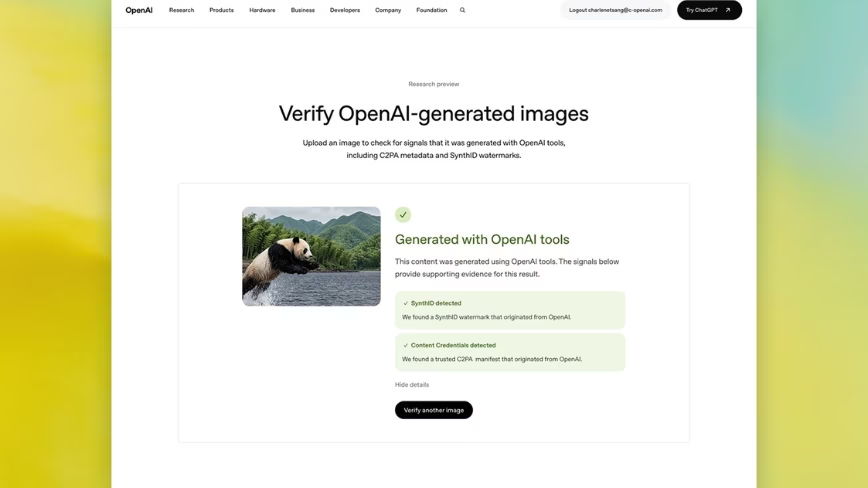
Alongside the announcement, OpenAI is previewing a public verification tool that checks for both C2PA credentials and the SynthID watermark. The tool will allow anyone to upload an image and determine whether it was generated by one of OpenAI’s models. The interface is designed to be simple: users drag and drop an image, and the tool analyzes it for provenance signals. Results are displayed as a clear indicator—such as a green checkmark or a red warning—along with detailed information about the image’s origin if available.
For now, the tool only covers images produced by OpenAI’s products, including DALL-E and ChatGPT with image generation. The company has said it hopes to expand its scope over time, potentially supporting other AI systems that adopt the same standards. However, that is a significant limitation. The flood of AI-generated imagery circulating online comes from a vast ecosystem of tools, many of which have little incentive to adopt provenance standards. OpenAI’s new measures can help ensure the company is not contributing to the problem, but they will do nothing to address images from less scrupulous sources.
The verification tool also raises questions about privacy and security. When a user uploads an image, the tool processes it remotely on OpenAI’s servers. The company states that uploaded images are not stored or used for training, but the process still involves transmitting data to a third party. For sensitive or confidential images, this could be a concern. OpenAI plans to release a client-side version that runs locally in the browser to mitigate these risks, but no timeline has been announced.
Part of a broader push
The announcement arrives amid growing concern from governments and civil society about the role of AI-generated content in misinformation and public discourse. The European Union’s AI Act, for instance, includes requirements for labeling of deepfakes and AI-generated content. Several U.S. states have also introduced bills mandating provenance disclosure. By adopting C2PA and SynthID, OpenAI is positioning itself ahead of potential regulatory mandates, while also trying to build public trust.
C2PA has attracted more than 6,000 members and affiliates as of early 2026, and its specification reached version 2.1 last year. OpenAI has now joined the coalition’s steering committee, positioning it alongside Adobe, Microsoft, and other founding members in shaping the standard’s future direction. This gives OpenAI a seat at the table where key decisions about metadata schemas, trust models, and enforcement mechanisms are made.
Google, for its part, has been expanding SynthID adoption across its own products, including Google Search, Google Images, and YouTube. The partnership with OpenAI marks the first time the technology will be embedded in a major rival’s outputs, a notable instance of cross-industry collaboration on AI safety and transparency. Such collaborations are rare in the competitive AI landscape, but the shared threat of misinformation seems to be driving companies to cooperate on foundational infrastructure.
Other major players are also moving. Meta has its own invisible watermarking technique for images generated by its AI tools. Adobe’s Content Credentials system, built on C2PA, is integrated into Photoshop and other Creative Cloud apps. Microsoft has announced support for C2PA in Bing Image Creator. However, the ecosystem remains fragmented: a single standard has not emerged, and many smaller AI startups have no provenance measures at all.
Technical challenges and limitations
Despite the promise of these technologies, significant challenges remain. For metadata-based approaches like C2PA, the biggest weakness is that metadata can be stripped unintentionally or maliciously. Social media platforms often compress images and strip metadata to save bandwidth. Even if the platform preserves the data, a user can take a screenshot which typically removes all metadata. Some platforms, like Twitter (now X), have started to preserve C2PA metadata for certain images, but adoption is spotty.
Watermarking approaches like SynthID face different challenges. While they are designed to survive transformations, they are not foolproof. Adversarial attacks—deliberate attempts to remove or corrupt the watermark—are an active area of research. Techniques such as adding noise, rotating the image a few degrees, or applying filters can sometimes degrade the watermark enough to evade detection. DeepMind has published research showing SynthID is robust against typical edits, but no watermark is unbreakable.
Another issue is the scalability of verification. The public tool announced by OpenAI only checks for its own watermarks and metadata. For a journalist or fact-checker trying to verify an image shared on social media, they would need to try multiple verification tools from multiple companies, each with its own interface and coverage. A unified verification service that can check all major provenance systems does not yet exist, though the C2PA coalition is working on a cross-platform validator.
There is also the problem of provenance for synthetic content that is combined with real content. For example, an AI-generated object pasted into a real photograph. The image as a whole may carry a watermark, but the real parts may not, leading to confusion. Current provenance systems typically treat the entire file as a unit, not individual elements. Advanced techniques that can attribute each pixel or layer are still experimental.
Industry and regulatory context
The push for better provenance comes against a backdrop of increasingly sophisticated AI-generated deepfakes. In the past year alone, there have been high-profile incidents where AI-generated images of politicians, celebrities, and events caused confusion and even stock market fluctuations. A fake image of an explosion near the Pentagon went viral on social media in 2023, causing a brief dip in the S&P 500. More recently, AI-generated images have been used in political campaigns to smear opponents or fabricate evidence.
Governments are responding with legislation. The European Union’s AI Act, which came into force in August 2024, requires that AI-generated content be clearly labeled, including images, videos, and audio. The act applies to all providers of AI systems operating in the EU, regardless of where they are based. Non-compliance can result in fines of up to 7% of global annual turnover. OpenAI, as a major provider, is clearly preparing for these requirements.
In the United States, the approach has been less centralized. Several states have passed laws requiring disclosure of AI-generated content in political advertisements. California’s AB 2396, effective in 2025, mandates that large AI platforms provide provenance tools. The federal government has also issued executive orders encouraging voluntary adoption of standards like C2PA. However, without a national law, enforcement is uneven.
Civil society groups have welcomed OpenAI’s announcement but caution that it is only one piece of the puzzle. “Content provenance is essential for digital trust,” said Dr. Elena Martinez, a researcher at the Center for Digital Ethics. “But it works best when every player in the ecosystem—from creators to platforms to end users—supports it. OpenAI’s move is positive, but we need a coordinated industry effort.”
Another key consideration is the impact on creators and artists. Some have expressed concerns that watermarking could be used to track or restrict the use of AI-generated images. OpenAI has clarified that the watermarks are only for provenance, not for digital rights management. They do not reveal the specific user who created the image, only that it was generated by an OpenAI model. However, as the technology evolves, privacy advocates worry that metadata could be expanded to include more personal information, potentially enabling surveillance.
Future outlook
OpenAI is not stopping with images. The company has hinted that similar provenance measures could be applied to text, audio, and video content. For text, adding invisible watermarks is far more challenging because digital text is essentially Unicode characters with limited space for embedded signals. Research is ongoing, but no reliable method for text watermarking has been widely adopted. For audio and video, SynthID has already been extended to work with generated audio, and Google is testing video watermarking.
The partnership between OpenAI and Google also opens the door for more cross-industry standards. Both companies are members of the C2PA steering committee, and they have shared technical expertise on watermarking. If they can agree on a common approach, it could pressure other major AI companies like Meta, Amazon, and Anthropic to adopt similar measures. However, competitive dynamics may hinder full cooperation—each company wants to maintain its own ecosystem and user base.
In the long run, the effectiveness of provenance systems will depend on widespread adoption by platforms where images are shared. Social media giants like Facebook, Instagram, YouTube, TikTok, and Twitter must check for and preserve provenance signals. Some have already started: YouTube displays a label for AI-generated content, and Instagram has a notification system. But many platforms still do not actively verify or display provenance information, making the signals invisible to most users.
Education is also critical. A provenance label is only useful if people understand what it means and trust it. OpenAI and Google have launched public awareness campaigns explaining how to use verification tools. Schools and libraries are beginning to teach digital literacy skills that include checking image provenance. But in the fast-paced world of social media, many users share content without ever pausing to verify its origin.
Ultimately, OpenAI’s adoption of C2PA and SynthID is a significant step forward, but it is not a silver bullet. The fight against AI-generated misinformation will require a combination of technical measures, regulatory frameworks, platform policies, and educated users. OpenAI’s actions set an example for the industry, demonstrating that transparency can be compatible with innovation. Whether other players will follow remains to be seen, but the pressure is mounting.