

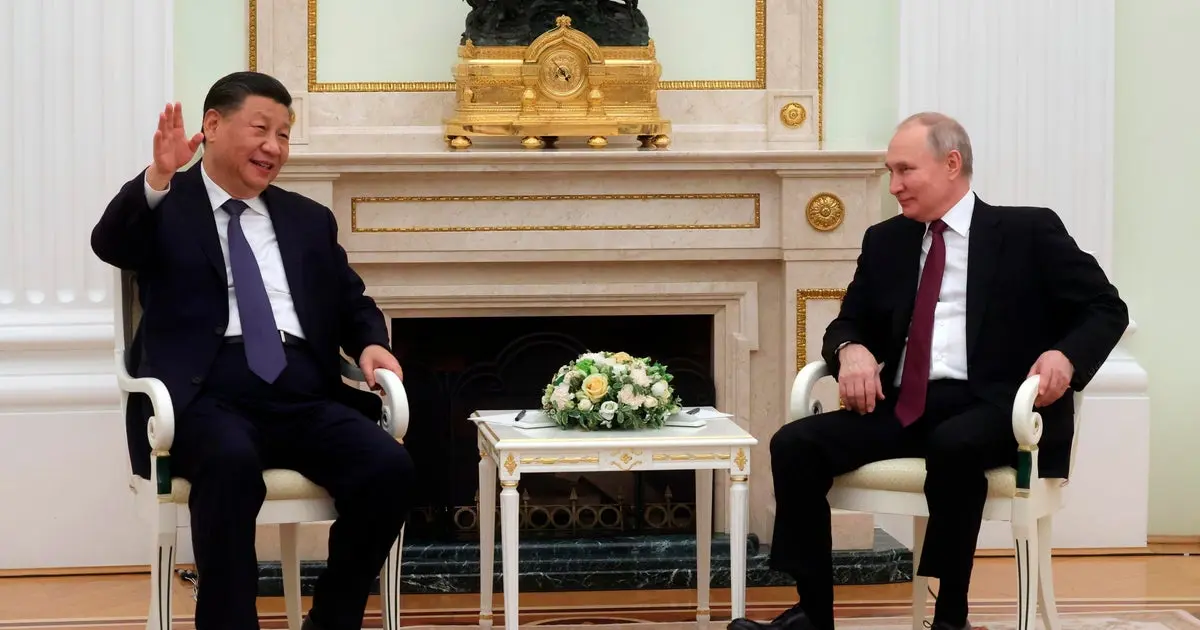
Russian President Vladimir Putin will meet with Chinese leader Xi Jinping on a two-day trip to Beijing next week, the Kremlin confirmed Saturday. The meeting, scheduled for May 19-20, comes just days after U.S. President Donald Trump completed his own state visit to China, underscoring the complex triangular dynamics among the world's major powers.
During the summit, Xi and Putin are expected to discuss a wide range of topics including bilateral relations, economic cooperation, and "key international and regional issues," according to the Kremlin statement. The visit coincides with the 25th anniversary of the 2001 Sino-Russian Treaty of Friendship, a foundational document that solidified the strategic partnership between Beijing and Moscow. After the meeting, the Kremlin said a joint statement "at the highest level" and several bilateral intergovernmental, interdepartmental, and other documents are expected to be signed.
Background of Sino-Russian Relations
The 2001 treaty, signed by Putin and then-Chinese President Jiang Zemin, established a framework for cooperation across multiple domains: political, economic, military, and cultural. Over the past two decades, relations between China and Russia have only grown closer, especially after the full-scale invasion of Ukraine in February 2022. Western sanctions isolated Russia economically and diplomatically, pushing Moscow to rely heavily on Beijing for trade, investment, and political support. China has become Russia's largest trading partner, with bilateral trade exceeding $240 billion in 2024, according to Chinese customs data.
Putin and Xi have met numerous times in recent years, frequently referring to each other as "dear friends" and "old friends." When Putin visited Beijing in September 2025 for the Belt and Road Forum, Xi warmly welcomed him, and the two leaders endorsed a new era of comprehensive strategic partnership. The relationship is often described as a "no limits" partnership, though both sides maintain that it is not a military alliance. Analysts note that while Russia provides China with energy resources, advanced weaponry, and a counterweight to U.S. influence, China offers Russia a crucial economic lifeline and diplomatic cover on the global stage.
Trump's Visit and Its Aftermath
The announcement of Putin's visit came less than 24 hours after President Donald Trump finished his own state visit to China. Trump's trip was characterized by warm rhetoric and public displays of camaraderie with Xi, including a joint walk on a red carpet and handshake photos that Trump later posted on Truth Social, calling Xi "a leader who is respected by all!" However, concrete outcomes from the Trump-Xi summit remained elusive.
During his visit, Trump discussed trade imbalances, the ongoing conflict in Iran, and other pressing issues. While Chinese officials opened the door to new areas of cooperation, no major trade deal was announced. Experts such as Wendy Cutler, a former negotiator in the Office of the U.S. Trade Representative, noted that "so far, it doesn't seem like Trump and his team have a lot to show for the visit." The lack of progress was particularly notable given Trump's campaign promises to rebalance trade with China and reduce the U.S. trade deficit.
Another contentious issue lingering after Trump's visit is the question of U.S. aid to Taiwan. The U.S. Congress approved a $14 billion arms sale to Taiwan in January, but Trump has delayed moving forward with the package. Leaders from both political parties have pushed Trump to support the island territory, which China considers a breakaway province. Beijing views arms sales to Taiwan as a violation of the One-China principle and has repeatedly warned against any actions that could undermine its sovereignty.
Geopolitical Implications of the Putin-Xi Summit
The timing of Putin's visit, so soon after Trump's departure, signals a deliberate effort by both China and Russia to reaffirm their strategic alignment. For Xi, hosting Putin reinforces the message that China is not isolated and that its partnership with Russia remains a cornerstone of its foreign policy. For Putin, the visit demonstrates that Russia still has powerful allies despite Western efforts to isolate it over Ukraine.
The summit will likely address several critical issues. First is the war in Ukraine: Russia continues to require support from China, both economically and diplomatically. China has refrained from condemning Russia's invasion and has rejected Western sanctions, though it has also called for a peaceful resolution. Second, economic cooperation will be a central topic. With Russia's economy increasingly oriented toward Asia, Beijing and Moscow are expanding trade in currencies other than the dollar, building new energy pipelines, and collaborating on infrastructure projects such as the Power of Siberia gas pipeline.
Additionally, the two leaders will discuss the situation in the Asia-Pacific region. The U.S. has strengthened its alliances with Japan, South Korea, and Australia, and has increased military exercises near China and Russia. Beijing and Moscow have responded by conducting joint naval and air patrols, including flights near Japanese and Korean airspace. The summit is expected to yield a joint statement addressing these security concerns.
Historical Context: The 25th Anniversary of the Treaty of Friendship
The 2001 Sino-Russian Treaty of Friendship, signed on July 16, 2001, was a landmark agreement that formalized the post-Cold War rapprochement between two neighboring powers. It established principles of mutual respect, non-aggression, and cooperation, and set the stage for a series of subsequent agreements on border demarcation, military confidence-building measures, and economic integration. Over 25 years, the treaty has evolved into a comprehensive strategic partnership that now encompasses over 30 major bilateral mechanisms and regular high-level exchanges.
To mark the anniversary, both sides are expected to issue a special statement and possibly new initiatives. The treaty's durability is remarkable given the dramatic changes in global politics since 2001, including the U.S. war on terror, the rise of China as an economic superpower, Russia's resurgence under Putin, and the ongoing confrontation with the West over Ukraine.
Economic Dimensions of the Visit
Economic ties between China and Russia have deepened significantly since the Ukraine war. Energy trade is a central pillar: Russia is China's largest supplier of crude oil, natural gas, and coal. In 2024, Russian oil exports to China reached a record high of 2.1 million barrels per day, displacing Saudi Arabia as the top source. Natural gas flows through the Power of Siberia pipeline, which is expected to reach full capacity by 2027, will supply up to 38 billion cubic meters annually.
Beyond energy, the two countries are expanding cooperation in agriculture, technology, and finance. Russia hopes to sell more grain, meat, and fertilizer to China, while Chinese companies are investing in Russian infrastructure projects. In 2023, the two countries agreed to increase the use of the ruble and yuan in bilateral trade, reducing reliance on the dollar and insulating themselves from U.S. financial sanctions.
During the summit, Xi and Putin are likely to announce new trade agreements and investment deals. The Kremlin has indicated that several bilateral documents will be signed, which could include a new cross-border payment system, a joint investment fund, or cooperation in space exploration. The meeting will also set the agenda for Putin's participation in the Asia-Pacific Economic Cooperation (APEC) summit in Shenzhen in November.
Taiwan and the US-China-Russia Triangle
One issue that is almost certain to be discussed is Taiwan. China has consistently opposed U.S. arms sales to Taiwan and views the island as a red line in its foreign policy. Russia has supported China's position on Taiwan, stating that the island is an inseparable part of China. The joint statement issued after the summit may reaffirm this stance and criticize U.S. interference.
The Trump administration has taken a somewhat ambiguous stance on Taiwan. While Trump has not yet approved the $14 billion arms sale, his administration has continued to sell weapons to Taipei through previous authorizations. The delayed sale has disappointed some Republican lawmakers who support a strong pro-Taiwan policy. Meanwhile, Beijing views any arms sale as a violation of the Three Communiqués that underpin U.S.-China relations.
The Putin-Xi meeting will also occur against the backdrop of rising military tensions in the Taiwan Strait. China has increased its military activities around the island, including war games and air patrols, while the U.S. has dispatched naval vessels through the strait. Russia has conducted joint naval drills with China in the East China Sea, and some analysts believe that the two countries may coordinate more closely in the event of a crisis over Taiwan.
Looking Ahead: APEC and Beyond
Putin's upcoming visit to China is not a one-off event. He is also scheduled to attend the APEC summit in Shenzhen in November, which will bring together leaders from across the Asia-Pacific region. For Putin, APEC provides an opportunity to engage with other Asian economies and showcase Russia's pivot to the East. For China, hosting APEC is a platform to promote its vision for regional cooperation and economic integration.
The deepening of the Russia-China relationship has implications for global governance. Both countries have called for a multipolar world order that reduces the dominance of the United States. They have cooperated in the United Nations Security Council, where they have vetoed resolutions against Russia over Ukraine and have opposed U.S.-led interventions in places like Syria. They are also members of the Shanghai Cooperation Organization and the BRICS group, which advocate for a reform of international financial institutions.
As Putin and Xi prepare to meet next week, the world will be watching for signals about the future of international alliances. While the U.S. remains the world's largest economy and military power, the axis between Beijing and Moscow is reshaping strategic calculations from Europe to Asia. The joint statement and any new agreements signed during the summit will provide the clearest evidence yet of how far these two countries are willing to go in challenging the existing order.
Source: Cbsnews News