

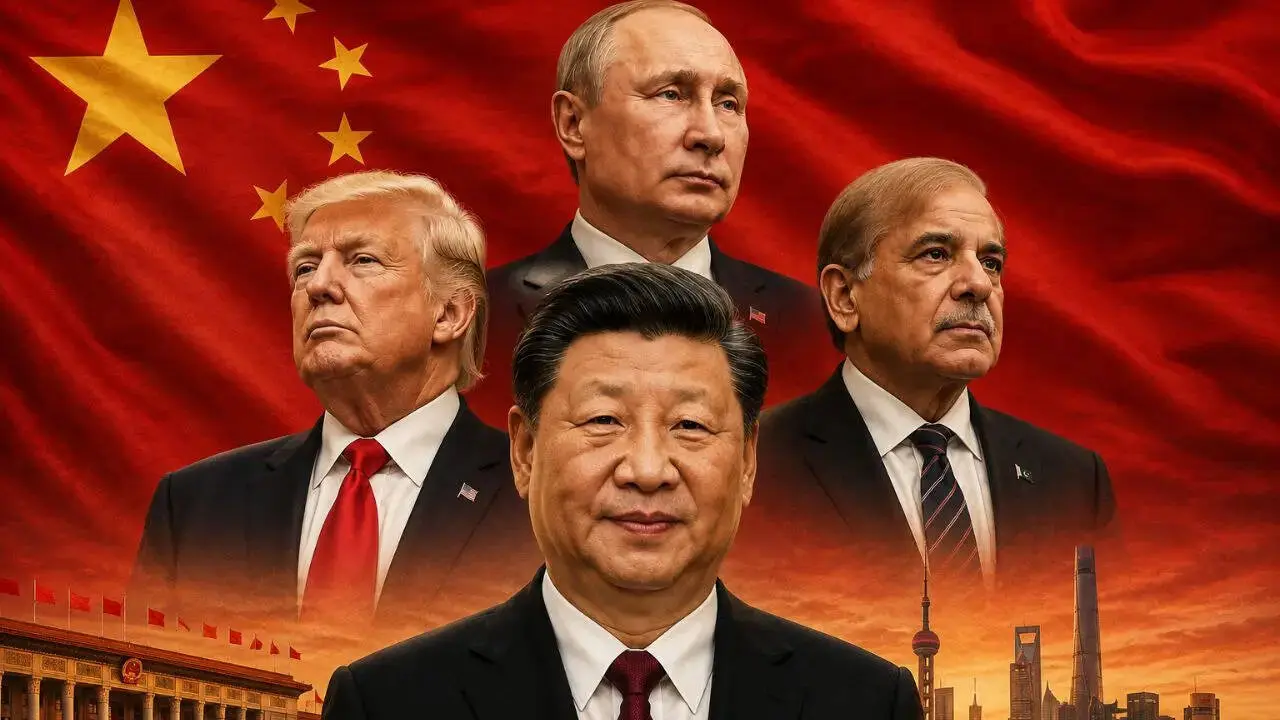
Watch the Great Hall of the People this month and you would think China has already won. Donald Trump came. Vladimir Putin came. This Saturday, Shehbaz Sharif arrives for a four-day state visit, and Tehran's foreign minister was here only weeks ago. Every side of the Iran war seems to need a Beijing address. The official narrative, echoed by a good deal of foreign commentary, reads all this as the arrival of the indispensable power.
It is not. The pull everyone senses is really just the absence of anywhere else to go, and the grand strategy they read into it does not exist.
Diplomatic Theater: A Crowded Calendar, No Grand Strategy
The flurry of high-profile visits to Beijing in 2026—from Trump to Putin to Sharif—creates an illusion of Chinese dominance. But those who have observed Chinese foreign policy for decades recognize it as pure pragmatism, not a master plan. China treats diplomacy like the way most Chinese treat religion: they will believe anything and commit to nothing. This instinct, not a blueprint for world domination, governs Beijing's every move.
In the Iran war, for instance, China plays both sides because both sides are available. Officially neutral, it keeps its relationship with Israel intact while quietly tolerating anti-Israel sentiment on social media—sentiment the censors would scrub within hours if it touched the Party. Officially a peacemaker nudging a ceasefire along, it has kept Iran supplied, and Russia too. For now this works. It will not work forever, because being everyone's address eventually means standing for nothing.
The Real Story: Domestic Crisis and Survival Anxiety
The real story is domestic, and it is not a confident one. China's labour force is shrinking. The property market has not so much corrected as collapsed. Youth unemployment got bad enough that Beijing simply stopped publishing the figure, then quietly changed how it was measured. Capital is leaving the country in the hundreds of billions. What keeps Xi Jinping awake is not the Strait of Hormuz. It is whether these pressures will loosen the Party's hold on power. Everything Beijing does abroad follows from that worry.
Demographic stress is perhaps the most underappreciated threat. China's population is aging rapidly, with the working-age population projected to fall by over 100 million by 2050. The one-child policy, while now abandoned, has left a legacy of a skewed sex ratio and a generation of only children burdened with supporting four grandparents. The social contract that once drove China's economic miracle—work hard, get rich, support the family—is fraying.
Economic growth, once averaging double digits, has slowed to around 4-5 percent, and even that is propped up by massive state investment. The private sector, which generates the majority of jobs and innovation, faces increasing regulatory uncertainty and capital flight. Entrepreneurs and investors are moving money to Singapore, the United States, and other havens. The property market crash has wiped out trillions in household wealth, and local governments—dependent on land sales—are drowning in debt.
These pressures create a feedback loop. To maintain stability, the Party cracks down on dissent, which in turn chills economic dynamism. To stimulate growth, it tries to rein in the state sector, which threatens patronage networks. Every policy response is a trade-off that risks intensifying the core crisis.
US-China Rivalry: The Only Relationship That Matters
This is why the relationship with the United States cannot be repaired by a summit. It is the only relationship that genuinely matters to Beijing, because the market China needs and the technology it still cannot make for itself are both American. Xi used the Iran crisis to buy himself some time. He invited Trump, lowered the temperature, and conceded nothing of substance. Genuinely opening up, the way Trump keeps demanding, would mean reforms the Party is convinced would weaken its own grip on the country. So Beijing manages the rivalry. It cannot end it. The conflict with America will run on, because the cure is something China cannot afford.
Technological decoupling is especially painful. Despite massive investments in artificial intelligence, semiconductors, and quantum computing, China remains dependent on US-designed chips and software. The US-led chip export controls have hobbled China's tech giants, forcing them to ration advanced chips for AI models. The goal of 'indigenous innovation' remains elusive, and the Party knows it. Every state-of-the-art facility built in China relies on equipment from ASML, Applied Materials, or Tokyo Electron—all under US influence.
Meanwhile, the trade surplus with the US has reached new highs, but that is a sign of weakness, not strength. As Chinese consumers grow poorer, they import less, while Chinese exporters still need American demand. The imbalance makes Beijing vulnerable to tariffs and sanctions, which Trump has not hesitated to impose.
Pakistan and Taiwan: Clients and Instruments
For Indian readers, the Sharif visit is worth watching without the usual alarm. The 'all-weather' partnership will be reaffirmed, CPEC toasted, the seventy-fifth anniversary of diplomatic ties duly celebrated. But Pakistan arrives in Beijing as a dependent, not a partner. It is useful to China precisely because it is pliable. That is not how a confident power builds an order. It is how a transactional one collects clients.
CPEC itself has been a mixed bag. Initial enthusiasm has given way to skepticism in Pakistan, where the promised jobs and prosperity have not materialized evenly. Debt concerns mount, and the security environment remains challenging. For China, the project is less about economic return and more about strategic leverage—a corridor to the Indian Ocean that also serves as a test case for the Belt and Road Initiative's sustainability.
Taiwan works the same way. The threats are real. The timetable is not. For Xi, Taiwan is mostly a domestic instrument, a way to keep nationalist feeling warm at home, not a war he is impatient to start. A failed invasion would do to his rule exactly what he fears most. He keeps the island tense because he is cautious, not because he is bold. Military exercises around Taiwan have become more frequent and more aggressive, but they are calibrated to avoid triggering a US response. The potential cost of an actual blockade or invasion—in lives, capital flight, and international isolation—is prohibitive for a regime that sees its own survival as the ultimate goal.
Even the South China Sea, another flashpoint, is managed with similar caution. China continues to build artificial islands and militarize outposts, but it avoids direct confrontation with the Philippines or Vietnam unless absolutely necessary. The strategy is to create facts on the ground while keeping the temperature below the boiling point.
An Anxious Party-State Improvising
China is an anxious party-state, making it up as it goes. The authoritarian advantage—speed of decision—is also its weakness: speed without deliberation leads to policy reversals and unintended consequences. The anti-corruption campaign, for example, was supposed to cleanse the bureaucracy but instead paralyzed decision-making, as officials feared taking any initiative. The crackdown on tech companies in 2021 wiped out billions in market value and drove away talent. The sudden U-turn on the zero-COVID policy in late 2022, after two years of stringent lockdowns, left the public disillusioned and the economy in a deep hole.
Globalization itself is coming apart, and that trend hurts China more than it helps. The rules-based international order, which China exploited to become the world's factory, is being replaced by blocs and sanctions. Supply chains are being reorganized to reduce reliance on China. The digital Silk Road faces resistance from countries wary of Chinese surveillance and data collection. Even the Global South, where China has invested heavily, is increasingly skeptical of debt traps and opaque deals.
Time is the one thing a run of short-term wins cannot buy. A crowded waiting room is not the same as a strong hand. China's leaders may continue to reel in visiting dignitaries, but behind the velvet curtains, the architecture is crumbling. The next five years will tell whether the regime can adapt—or whether the cracks will widen beyond repair.
The world should watch not the guest list in Beijing, but the protests in small factory towns, the empty apartments in once-booming second-tier cities, and the growing list of accounts frozen for 'illegal capital flight.' That is where the real story of China's power lies.
Source: TimesNow News