

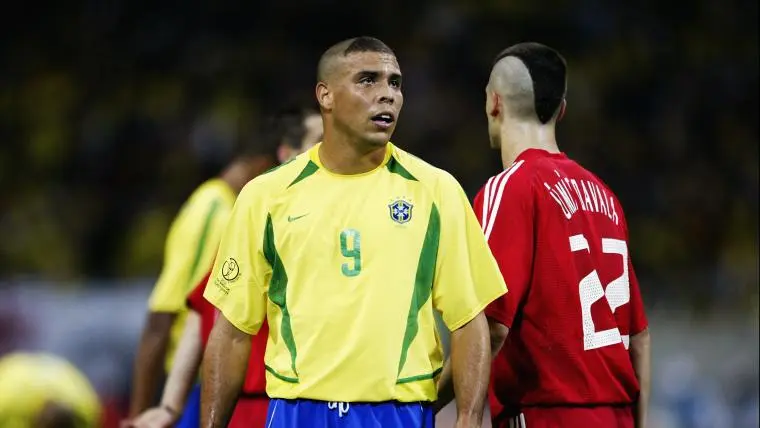
A whole generation of world football fans knows the name Ronaldo because of one man: Cristiano, the legendary Portugal goal scorer who played in his sixth World Cup in 2026. However, Cristiano Ronaldo is not the original Ronaldo. One of the greatest scorers ever shared that name, and he came first. Throughout the 2026 World Cup, that man — Ronaldo Nazario — was shown on television broadcasts, in attendance at games, watching this generation of stars shine on the pitch. It's worth remembering just how special the original Ronaldo really was.
Who is the original Ronaldo?
The Ronaldo before Cristiano was named Ronaldo Luis Nazario de Lima — Ronaldo Nazario, for those talking about the history of the game. At the time, the Brazilian striker was known simply as Ronaldo. He didn't need another name. He had epic nicknames — O Fenômeno, and R9. He also had one of the great resumes of any era. Ronaldo Nazario won two Ballon d'Or awards as the top player in the world, in 1997 and 2002. With Brazil, he won a pair of World Cups, including as a 17-year-old in 1994 and then in the magnificent front three with Ronaldinho and Rivaldo in 2002, when Ronaldo scored twice in the final and won the Golden Boot. Ronaldo scored 15 goals in his World Cup career, which was a record before Miroslav Klose and Lionel Messi came along. In all, Ronaldo played 98 matches for Brazil, scoring 62 goals. At club level, he played for Cruzeiro, PSV, Barcelona, Inter Milan, Real Madrid, AC Milan and Corinthians, scoring 280 goals in his club career. Now 49 years old, Ronaldo owns Real Valladolid in Spain.
But his career was not just about statistics; it was about style, flair, and an almost supernatural ability to score goals. He burst onto the scene at Cruzeiro in Brazil, where his goal-scoring prowess attracted European scouts. A move to PSV Eindhoven followed, where he continued to impress. However, it was at Barcelona where he truly became a global phenomenon. Under the guidance of Sir Bobby Robson, Ronaldo scored 34 goals in 37 matches in the 1996–97 season, helping the club win the Copa del Rey, the European Cup Winners' Cup, and the Supercopa de España. His performances earned him his first Ballon d'Or in 1997.
His transfer to Inter Milan for a world-record fee of $27 million in 1997 marked the beginning of a new chapter. In Italy, he faced some of the toughest defenders in the world, yet he continued to score at an astonishing rate. He won the UEFA Cup with Inter in 1998 and was named FIFA World Player of the Year twice. However, injuries began to plague his career. A series of knee problems, including a devastating patellar tendon rupture in 1999, threatened to derail his progress. Many believed he would never return to his best, but Ronaldo was determined. After years of rehabilitation, he made a remarkable comeback in the 2002 World Cup, where he silenced his critics by leading Brazil to their fifth title. His two goals in the final against Germany were a testament to his resilience and skill.
After the World Cup, he moved to Real Madrid for another world-record fee, forming part of the 'Galácticos' alongside Zinedine Zidane, Luís Figo, and David Beckham. With Real Madrid, he won the La Liga title in 2003 and finished as the league's top scorer in 2003–04. However, his time in Madrid was also marked by injuries and a gradual decline in form. He later had spells at AC Milan and Corinthians before retiring in 2011. Despite the injuries, his legacy as one of the greatest players of all time remains intact.
More than anything, it's ironic that his name has been adopted in a new generation by an entirely different footballer. But it takes just a moment on the screen, when the announcers realize who's being shown in the stands, to recognize the original Ronaldo's impact. They speak of him with awe, because he was a player who warranted such tones. Cristiano Ronaldo is one of the most accomplished players in this sport's history. But Ronaldo Nazario came first.
Key facts about Ronaldo Nazario
- Full name: Ronaldo Luís Nazário de Lima
- Born: September 18, 1976, in Rio de Janeiro, Brazil
- Position: Striker
- Major honors: Two FIFA World Cups (1994, 2002), two Ballon d'Or awards (1997, 2002), FIFA World Player of the Year (1996, 1997, 2002), UEFA Cup (1998), La Liga (2003), Copa del Rey (1997), and many more.
- World Cup goals: 15 goals in 19 matches (1994–2006)
- Club career goals: 280 in 491 matches across all clubs
- International goals: 62 in 98 appearances for Brazil
- Nickname: O Fenômeno (The Phenomenon), R9
- Post-retirement: Owner of Real Valladolid since 2018
The impact of Ronaldo Nazario on football
Ronaldo Nazario changed the way strikers were perceived. Before him, many forwards were either poachers or target men, but Ronaldo combined pace, power, and technique in a way that had never been seen before. His ability to dribble past defenders with ease, his explosive acceleration, and his clinical finishing made him a nightmare for defenders. He was a complete striker, capable of scoring from any angle or distance. His style inspired a generation of players, including Cristiano Ronaldo himself, who has often cited the Brazilian as one of his idols.
Off the pitch, Ronaldo was a global icon. His endorsement deals with Nike, Coca-Cola, and other brands made him one of the most marketable athletes in the world. He also became a symbol of hope for many after overcoming career-threatening injuries. His comeback in 2002 is still regarded as one of the greatest in sports history.
At the 1998 World Cup in France, Ronaldo was at the peak of his powers before the final. He suffered a mysterious seizure on the day of the final, which affected his performance as Brazil lost to France. Theories and conspiracy surrounded the incident, but Ronaldo's resilience saw him return stronger. Four years later, he redeemed himself by scoring eight goals in the tournament, including the decisive brace in the final.
His record of 15 World Cup goals stood for a decade until Klose surpassed it in 2014. Even today, only a handful of players have scored more. His legacy is not just in numbers but in the memories he created: the step-overs, the burst of speed, and the celebration with his arms outstretched.
While Cristiano Ronaldo has become synonymous with modern football excellence, it is important to remember that the name Ronaldo was first made famous by a Brazilian boy from Rio who conquered the world with a ball at his feet.
Source: Yahoo Sports News