

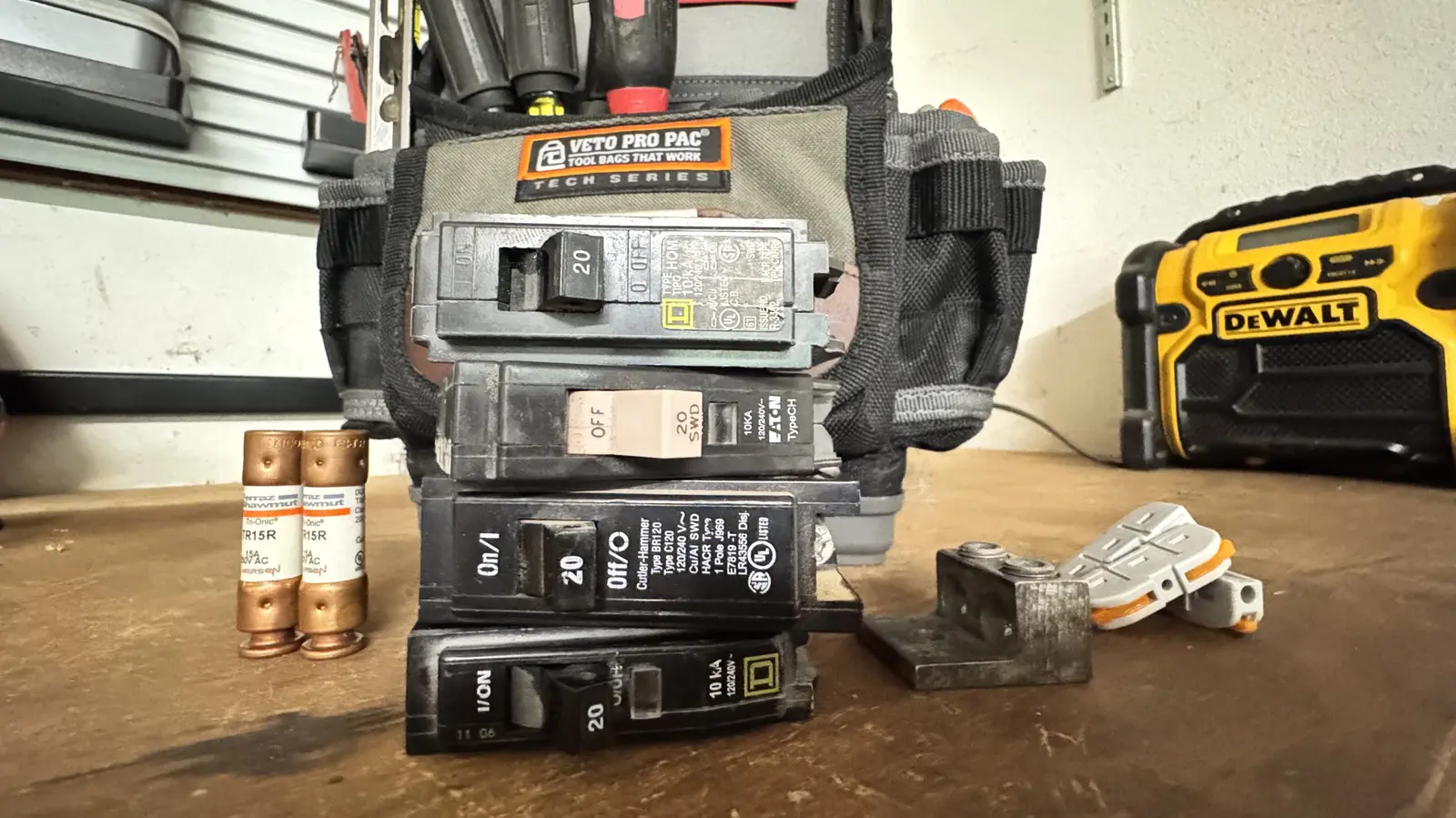
Circuit breakers are critical components of any electrical wiring system. Also known as an Overcurrent Protection Device (OCPD), a circuit breaker can come in a variety of different forms – ranging from the commodity 15A residential circuit breakers you'd find at a big box DIY store that cost a few dollars, to giant, molded-case industrial breakers that are rated for 1,600 amps and cost thousands of dollars. Circuit breakers can vary wildly in form and features, but they all share a common function: to protect a circuit against overcurrent, overload, and short-circuits. This in turn protects people, property, and equipment.
As circuit breakers have evolved over the years, the National Electrical Code (NEC) standards have constantly evolved to address their role and implementation. One of the longest-standing rules for circuit breakers is the 80% rule, whereby a standard circuit breaker can only be loaded to 80% of its rating for continuous loads. The origin of this rule is often misunderstood, as it is not technically in the NEC; rather, its basis is in certain NEC specifications and UL listings governing breaker ratings and how they are applied.
The 80% rule is a duty limitation placed on the breaker to protect the device itself, similar to how the 80% rule applies to generators. This is because standard breakers use terminals that are not tested to operate at 100% of the breaker's rating forever. There are also thermal limitations in the environments where breakers are installed, such as ventilation, and how much heat adjacent breakers are generating. There are breakers that are specifically tested to operate at 100% duty indefinitely, but they are tested differently, and also require certain installation conditions to be met, meaning they can only be installed in enclosures with specific spacing and ventilation requirements.
To fully understand the 80% rule, it helps to understand what a continuous load is. According to the NEC, a continuous load is one where the maximum current is expected to continue for three hours or more. Typical examples include lighting circuits in commercial buildings, electric vehicle chargers, and heating systems. Non-continuous loads, on the other hand, are those that operate intermittently, such as power tools or kitchen appliances. The distinction is important because continuous loads generate sustained heat, which can degrade the circuit breaker's components over time.
The 80% rule is derived from NEC Article 210.20(A), which states that where a branch circuit supplies continuous loads or a combination of continuous and non-continuous loads, the rating of the OCPD shall not be less than the non-continuous load plus 125% of the continuous load. Mathematically, 1 divided by 1.25 equals 0.8, hence the 80% rule. However, the NEC does not explicitly state “the 80% rule.” This common phrasing comes from the practical application: if you have a continuous load of 16 amps, you need a breaker rated at least 20 amps (16 x 1.25 = 20). Conversely, a 20-amp breaker can only carry a continuous load of 16 amps (80% of 20).
Underwriters Laboratories (UL) Standard 489, which governs circuit breakers for use in North America, also drives the rule. UL 489 tests breakers under specific conditions to ensure they can safely interrupt fault currents and handle thermal stress. Standard breakers are tested at 100% of their rating only for short durations (typically less than three hours) and are not intended to carry full load continuously. The heat generated at the breaker's lugs and internal contacts can cause thermal expansion, contact degradation, and eventually nuisance tripping or failure if the load persists. The 80% rule provides a safety margin that accounts for ambient temperature, installation in crowded panels, and the cumulative heat from multiple breakers.
It is important to note that there are breakers specially rated for 100% continuous duty. These breakers are identified by a label stating “100% rated” and have undergone additional testing per UL 489. They often feature heavier lugs, larger heat sinks, or different internal materials to dissipate heat more effectively. However, their installation requires specific conditions: the enclosure must provide adequate ventilation, and the breaker must be installed with proper spacing between adjacent devices. In practice, 100% rated breakers are used in industrial settings where continuous high loads are unavoidable, such as data centers, manufacturing plants, and large commercial kitchens.
The history of the 80% rule dates back to the early days of electrical distribution. In the early 20th century, electrical systems used fuses, which were less predictable and required replacement after each overload. As molded-case circuit breakers became common in the 1950s and 1960s, engineers recognized that thermal-magnetic trip units could be affected by ambient heat. The NEC and UL collaborated to establish conservative ratings that would ensure safe operation under all realistic conditions. Over the decades, the rule has been reaffirmed with minor tweaks, including clarifications on how to calculate mixed loads and the introduction of 100% rated breakers in the 1996 NEC.
The 80% rule has practical implications for electricians and engineers when designing circuits. For example, when sizing a branch circuit for a 20-amp continuous load, you must choose a breaker rated at least 25 amps (20 x 1.25). But standard breaker sizes are available as 15A, 20A, 25A, 30A, etc. A 25-amp breaker is less common, so often the designer would use a 30-amp breaker for that continuous load. However, the conductors (wires) must also be sized appropriately. The 80% rule is separate from the conductor ampacity derating, which is another NEC requirement. An electrician must consider both to ensure a safe, code-compliant installation.
Misconceptions about the 80% rule abound. Some believe it means a breaker will trip at 80% of its rating, but that is false. A 20-amp standard breaker will still carry 20 amps for a short duration (up to three hours) without tripping. The rule applies only to continuous loads. For intermittent loads, you can load a breaker up to 100% of its rating. Also, the rule does not apply to the short-circuit or ground-fault rating of the breaker; it is solely a thermal duty limitation. Another common error is applying the 80% rule to the load calculation rather than the breaker sizing. The correct method is to take the continuous load plus 125% of that load to size the breaker, not to load the breaker at 80%.
Understanding the 80% rule also requires knowledge of how heat affects electrical components. Every breaker has a thermal element that bends when heated, causing the trip mechanism to activate if the current exceeds the rating. If a breaker is consistently operated near its maximum rating, the thermal element may degrade, and the ambient temperature in the panel may increase. In a panel with many breakers, the heat from each breaker adds up, potentially causing nuisance tripping of nearby breakers. The 80% rule helps mitigate these issues by ensuring the breaker operates in the lower part of its thermal curve.
In residential settings, the 80% rule is critical for circuits that supply large appliances like ovens, dryers, air conditioners, and electric vehicle chargers. For example, a Level 2 EV charger that draws 32 amps continuously (80% of a 40-amp circuit) requires a 40-amp breaker, not a 32-amp breaker. Because EV charging can take several hours, it qualifies as a continuous load. Similarly, a 5-ton central air conditioner with a compressor that runs for hours in summer needs careful breaker sizing. Failure to adhere to the 80% rule can result in tripping breakers, overheating, or even electrical fires.
The NEC also applies the 80% rule to other OCPDs, including fuses and supplementary protectors. However, the rule is most frequently associated with standard molded-case circuit breakers because they are ubiquitous. The rule does not apply to all devices; for example, some transient voltage surge suppressors or motor controllers have different duty cycles. In industrial settings, the 80% rule may be relaxed if load monitoring and thermal management systems are in place, but such exceptions must be explicitly permitted by the authority having jurisdiction.
In summary, the 80% rule is not a standalone code article but a practical interpretation of NEC requirements and UL testing standards. It ensures that standard circuit breakers are not overloaded continuously, thereby extending their lifespan and reducing fire risks. By understanding the distinction between continuous and non-continuous loads, electricians and engineers can design safe and efficient electrical systems. For those needing to operate breakers at 100% duty, special 100% rated devices are available, but they come with strict installation guidelines. As electrical technology advances, with the rise of renewable energy systems and high-demand appliances, the 80% rule remains a cornerstone of electrical safety.
Source: SlashGear News