

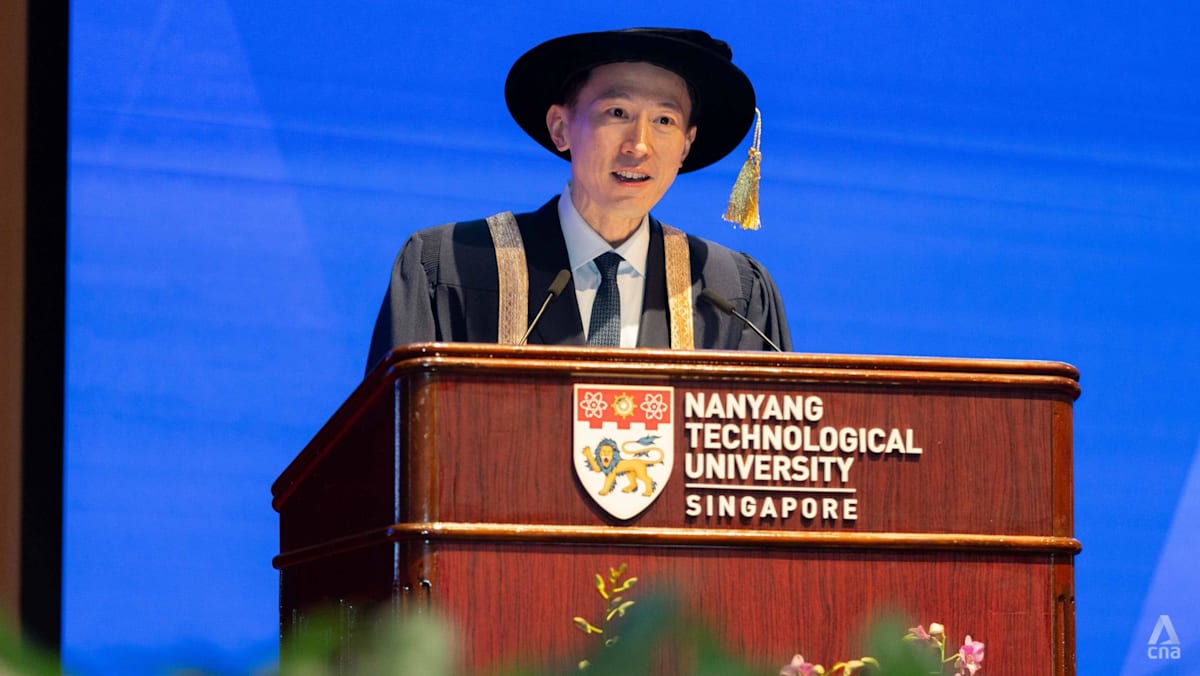
SINGAPORE - TikTok chief executive officer Chew Shou Zi on Saturday (Aug 1) urged doctoral graduates at Nanyang Technological University (NTU) to 'actively seek the unknown' and use their hard-won expertise to tackle messy, real-world challenges.
In a 10-minute address at a PhD conferment ceremony, the 43-year-old Singaporean spoke candidly about his modest beginnings in Yio Chu Kang, his early fascination with computers, and the unlikely path that took him from a primary school in the heartland to the helm of one of the world's most recognisable social media platforms.
Mr Chew's speech was part of NTU's 2026 convocation, which will see more than 14,000 students from the class of 2026 graduate across 29 ceremonies. This year's cohort is the largest in the university's history. The ceremony for doctoral graduates was held in two sessions on Saturday, with 575 graduates receiving their PhDs. Mr Chew delivered his remarks to those at the first session in the morning.
NTU's convocation is a milestone for the university community, bringing together faculty, families and supporters to celebrate years of research and study. For the doctoral graduates, in particular, the ceremony marks the end of a demanding journey that often involves years of original research, publication and rigorous examination. Many of them will go on to careers in academia, industry and government, where their specialised knowledge will shape policy and innovation.
A call to embrace uncertainty
Mr Chew told the graduates that they are entering the workforce at a time of massive structural change, driven by rapid advances in artificial intelligence and other frontier technologies.
'We see it every single day, and an unprecedented big picture innovation era. This is a pivotal and exciting point in history - where change is not constant, but exponential and compounding,' he said.
His central message was simple: doctoral graduates should not retreat into comfortable, well-defined roles. Instead, they should deliberately place themselves in unfamiliar situations.
'You have just spent years earning a PhD, proving that you already know how to push the boundaries of human knowledge. Now, take that superpower and apply it to the messy, ambiguous problems of the real world,' he said.
He urged them to seek out rooms where they are the least experienced person. 'Embrace uncertainty because that is where meaningful innovation happens. As you go out there, rely on the network of brilliant peers sitting around you today, because they are your community.'
The community, Mr Chew added, would remind them of their purpose and reflect what they are truly capable of. He encouraged the new doctors to preserve the curiosity that first set them on their academic journey, describing education as a 'lifelong passport' that keeps expanding the borders of a person's world.
His speech also resonated with broader debates about the role of advanced degrees in a fast-changing labour market. As machines take on more routine cognitive tasks, the value of human judgment, creativity and the ability to frame meaningful questions becomes more important. For PhD holders, the challenge is not just to produce knowledge, but to translate that knowledge into decisions, products and services that improve lives.
From Yio Chu Kang to the global stage
Reflecting on his roots, Mr Chew described his early world as 'hyperlocal.'
'My universe did not extend much further than my own neighbourhood in Yio Chu Kang, and the comfortable rhythm of my daily routine, and the familiar surroundings that I see every day,' he said.
His first major leap came after his Primary School Leaving Examination, when he travelled from Yio Chu Kang to Bukit Timah to attend what is now known as Hwa Chong Institution. Although the distance was not great, the decision tested him.
'I know Yio Chu Kang to Bukit Timah is not that far, but choosing to go there completely pushed me out of my comfort zone,' he said.
That move sparked an intellectual curiosity that stayed with him. He said it showed him that his potential could be as limitless as his imagination and untouched by physical boundaries. He drew a parallel with Singapore itself, describing the small island nation as a place that, through curiosity and resilience, has always looked outward and upward to create an oversized global footprint.
Mr Chew's reflections on Singapore's outward-looking mindset were particularly relevant at a ceremony held in the city-state, which has made research and innovation central to its economic strategy. For generations of Singaporean students, education has served as both a personal and national project, opening doors to opportunity while contributing to the country's development.
An unexpected journey through finance and technology
Mr Chew acknowledged that his path differed from that of the doctoral graduates before him, but said his career had also been built on following curiosity and a belief that impact often requires doing things differently than expected.
That belief took root when his father bought him a 286 computer, powered by an Intel processor released in 1982. He joked that he did not use it to write brilliant software.
'I would love to tell you that I was using the computer to code some brilliant software and building the future, but the reality is I was playing computer games, a lot of it,' he said, drawing laughter from the audience.
Yet those hours at the keyboard nurtured a lasting love for technology. After leaving home, he studied economics at University College London, worked at Goldman Sachs in London, and later earned a Master of Business Administration at Harvard Business School.
He said he chose that route because he was fascinated by where global business and investment were heading. Working in finance gave him a unique vantage point on the world, as major investments poured into innovative new ideas and early-stage technology startups.
'It was eye-opening to witness how much life was changing,' Mr Chew said. 'Over time, that pull I felt towards technology when I was younger kept resurfacing and that is the beautiful thing about genuine curiosity. It is incredibly resilient. It always brings you back to where your passions lie.'
His finance background became a bridge to the technology world. After his MBA, he interned at Facebook and later joined a venture capital firm, leading investments in Chinese tech companies such as JD.com, Alibaba and Xiaomi, as well as ByteDance, the parent company of TikTok. In 2015, he became chief financial officer of Xiaomi. In March 2021, he accepted ByteDance's offer to become TikTok's CFO, and two months later he was appointed CEO of the social media platform, with founder Zhang Yiming praising his deep knowledge of the company and industry.
In the years since, TikTok has become one of the most downloaded apps in the world, influencing culture, commerce and communication. The company has faced scrutiny from regulators and governments across multiple jurisdictions, yet it has continued to expand its user base and introduce new features. Mr Chew's leadership has involved balancing the platform's creative mission with questions around data governance, online safety and geopolitical tensions.
Leading TikTok in the age of AI
Mr Chew told the graduates that running a global company that enriches lives by reshaping how people express creativity, find communities and discover joy is one of the greatest pleasures of his life.
Growing up in an analogue world, launching his career during digital transformation, and now leading a major platform in the age of artificial intelligence taught him an important lesson: technology is not just about hardware and code, it is about unlocking human potential.
'It is about taking a single idea and giving it the scale to reach millions or billions, if you are lucky. It is removing barriers between us and giving everyone with a story to tell the global stage to connect with others,' he said.
He told the doctoral graduates that their field has the same power: the ability to take complex knowledge and turn it into something that enriches people's lives. He encouraged them to reflect on the wider purpose of their work, not just its technical details.
His advice was grounded in a conviction that meaning and innovation are often found outside familiar territory. By surrounding themselves with a strong community of peers and continuing to ask ambitious questions, Mr Chew said, the graduates would be well-prepared for whatever comes next.
Mr Chew's remarks also highlighted a theme often heard at university ceremonies: the importance of humility. Even with elite credentials, he told graduates, they would need to keep learning. The doctorate, in his view, was not an end point but a foundation for a lifetime of questioning.
He closed his speech by congratulating the class of 2026 and telling them that the future belongs to them.
'The world is yours and I can't wait to see what you do with it,' he said.
Source: CNA News