

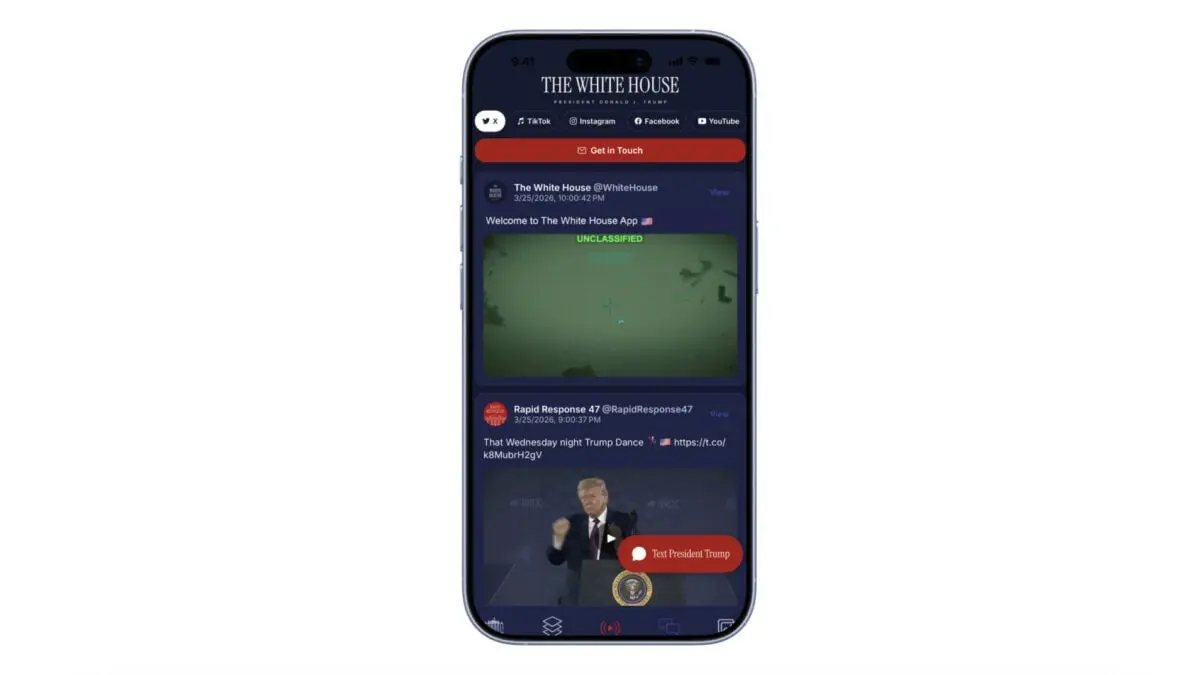
The Trump administration is taking an aggressive step toward consolidating communication channels within the federal government: the official White House mobile app will soon be automatically loaded onto every smartphone issued to Department of Homeland Security personnel. The move, first reported by Politico, mirrors a tactic familiar to smartphone users—the infamous 2014 U2 album that quietly landed on millions of iPhones—but the stakes here involve national security, government surveillance, and the digital privacy rights of federal employees.
The app, which launched in March 2026, is advertised on WhiteHouse.gov as offering 'unfiltered, real-time updates straight from the source.' That source is President Donald Trump himself. In a press release, the White House described the app as 'a convenient way to access official White House communications, including announcements, executive actions, speeches, livestreams, videos and other updates.' The top feature highlighted is 'breaking news alerts on major announcements, executive actions, and other key priorities.' To illustrate the app's interface, the White House provided a screenshot showing a post reading 'That Wednesday night Trump dance🕺🇺🇸'—a choice that some might view as emblematic of the app's tone.
What the App Offers
According to the official listing, the White House app includes several core functions:
- Live video streaming of White House events and press briefings
- A 'library' of archived audio and video clips, presumably featuring Trump's speeches and statements
- A 'Stay Connected' section for updates on new policies and executive orders
- A feedback mechanism that allows users to send comments, including voice recordings
However, a more granular analysis by the watchdog site Notus.org revealed that the app also collects a substantial amount of user data—including time zone, IP address, device identifiers, and location—and shares that data with third-party partners. Notus noted that the app 'doesn’t disclose its data sharing the way most others do,' raising red flags about transparency. The privacy policy, buried in the app's terms, reportedly allows the White House to transfer data to analytics firms and advertising partners without explicit user consent.
Security Experts Sound the Alarm
The forced installation of any third-party application onto government-issued devices is highly unusual. Historically, federal agencies maintain tight control over their Mobile Device Management (MDM) systems to prevent unauthorized software that could create vulnerabilities. Sonny Hashmi, a former IT executive at the General Services Administration (GSA), told Government Executive that the auto-install is 'cause for alarm.' Hashmi explained, 'Any app that is installed on government‑issued devices can potentially create backdoor access to government networks behind the firewall. Even if the app itself is benign, its integration with operating‑level permissions could be exploited by malicious actors.'
Hashmi's concerns echo a broader debate in cybersecurity circles about the risks of 'sideloaded' applications in enterprise environments. Government devices are typically equipped with security protocols that restrict app installations to a curated list approved by the agency's IT security team. Bypassing those controls—especially via an executive memorandum from the White House—sets a precedent that could undermine years of security hardening. Moreover, the app's data-collection practices could expose sensitive location and communication patterns of DHS employees to third parties, some of whom may be based in countries with less stringent privacy protections.
The Department of Homeland Security itself has not publicly commented on the directive. However, internal emails obtained by Politico indicate that the agency's IT department received instructions to 'expedite the deployment' of the app, with a target of full installation within 30 days. Employees who attempt to remove the app may face administrative penalties, as the app could be flagged as a required configuration policy under the MDM system.
Historical Parallels and Legal Implications
This is not the first time a White House has released a mobile app. In 2010, the Obama administration launched its own version of the White House app, which provided similar features—news updates, video streams, and contact information. That app, however, was voluntary; users downloaded it from app stores if they chose to. The Obama-era app did not auto-install on any government devices, and it underwent standard privacy reviews by the GSA.
The current app's mandatory nature raises constitutional questions under the Fourth Amendment, which protects against unreasonable searches and seizures. Government employees may have a reduced expectation of privacy on work-issued devices, but courts have generally held that blanket surveillance without a warrant still requires a legitimate work-related purpose. Forcing an app that collects location data, IP addresses, and other behavioral information could be challenged as an overreach, especially if the data is shared with third parties without clear oversight.
Legal scholars have also pointed to the Privacy Act of 1974, which restricts how federal agencies collect and use personal information. The White House Office of Administration is not typically classified as an 'agency' under the Act, creating a loophole that could allow the app to operate outside traditional privacy safeguards. This ambiguity is likely to be tested in court if employees file complaints through the Office of Special Counsel or the Federal Labor Relations Authority.
The Broader Context of Federal Device Management
The forced installation follows a pattern of the Trump administration centralizing control over federal communications. Earlier this year, the White House issued a memo requiring all federal agencies to adopt a standardized 'Digital Engagement Platform' for public outreach. The app appears to be the primary tool for that platform. Critics argue that this centralization could be used to curate or even suppress information that contradicts administration narratives. For instance, if the app’s 'breaking news alerts' are the only official notification channel, agencies may feel pressured to rely on it rather than their own established communication methods.
Furthermore, the auto-install creates a precedent that could be exploited by future administrations. If a president can mandate an app on every DHS device, what stops a future president from installing an app that tracks employee dissent or monitors compliance with political loyalty oaths? Cybersecurity experts note that once an app gains root-level or device administrator privileges—as many enterprise apps do—it can be difficult to remove without wiping the device entirely.
The situation has drawn comparisons to the 2014 U2 album 'Songs of Innocence,' which Apple automatically downloaded to all iTunes accounts. Many users reacted with outrage, calling it digital intrusion. The difference here is that federal employees cannot simply delete the app; their phones are government property, and refusing to comply could have career repercussions. A DHS employee who spoke to Politico on condition of anonymity said, 'We feel like we’re being used as a testing ground for something that hasn’t been properly vetted. It’s unsettling.'
What Comes Next
As of the publication date, no federal employee union has filed a grievance, but legal experts anticipate challenges. The American Federation of Government Employees (AFGE), which represents DHS workers, is reportedly reviewing the installation directive to determine whether it violates collective bargaining agreements or privacy protections. Meanwhile, the Federal Trade Commission (FTC) may have jurisdiction over the app’s data-sharing practices, though the White House is generally exempt from FTC oversight.
For now, DHS employees are advised to be aware that their devices will soon carry an app that systematically collects their digital footprint. The White House insists the app is about transparency and efficiency—the press release calls it 'a convenient way to stay informed.' But for the men and women tasked with enforcing the nation’s immigration, customs, and security laws, the app may feel less like a convenience and more like a silent partner in their daily work.
Ironically, the very agency that monitors cyber threats to the homeland is now being required to install software that its own IT specialists consider a potential vulnerability. Whether the app ultimately improves communication or opens a gateway to surveillance will depend on how it is audited and controlled. As one former GSA official put it, 'Trust but verify'—and in the case of the White House app, verification has been conspicuously absent.
Source: Gizmodo News