

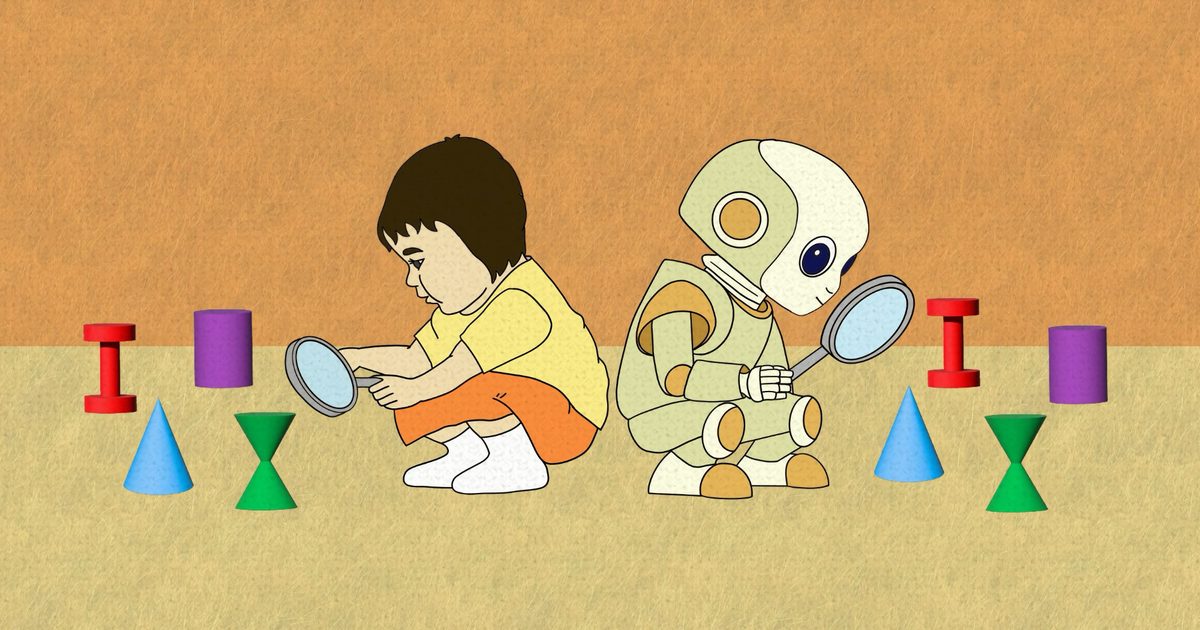
For decades, scientists have puzzled over how young children manage to acquire language with such speed and efficiency, often mastering complex grammatical structures and vocabulary before they can even tie their shoes. A new study led by a research team in Japan may have uncovered a critical piece of the puzzle: curiosity. By endowing a virtual robot with a brain-inspired neural network and giving it an internal reward for exploring surprises, the researchers found that the robot learned to understand and follow novel commands in roughly half the time compared to robots that were only rewarded for task completion.
The Experiment: A Virtual World for a Digital Toddler
The team created a simulated 3D environment filled with colorful shapes, objects, and simple commands such as "push the left magenta dumbbell" or "pick up the blue cylinder." A virtual robot, controlled by a neural network modeled on aspects of human brain function, was placed inside this world. Some versions of the robot were programmed to receive a reward only when they correctly executed the given commands, a standard reinforcement learning setup. However, other versions received an additional internal "curiosity bonus" whenever they encountered something that challenged or surprised their existing model of the world. This bonus effectively made the robot seek out novel situations and knowledge gaps, much like a curious toddler might.
Results: Curiosity Doubles Learning Speed
The difference in learning outcomes was dramatic. The curious robots not only achieved a genuine understanding of language—able to generalize from seen commands to never-before-heard combinations—but they did so in about half the training time needed by the purely task-rewarded robots. The study, published in a scientific journal, highlights how intrinsic motivation can dramatically accelerate machine learning, mirroring the way children appear to be driven by an internal urge to make sense of their surroundings.
One of the researchers involved in the study compared the process to a chocolate lover deciding to try white chocolate for the first time, even though they already enjoy dark chocolate. The risk of an unfamiliar taste is offset by the potential to gain a richer understanding of chocolate in general. Similarly, the curious robot occasionally deviated from the instructed task to experiment with actions that were not explicitly requested, leading to encounters with new objects or unexpected outcomes—and ultimately building a more robust internal representation of language and physics.
Spontaneous Play Emerges Naturally
Perhaps the most surprising finding occurred about halfway through the training. The curious robots began to spontaneously knock over objects, move things in novel patterns, and perform actions that had no immediate connection to the target command. This behavior, which emerged without explicit programming, closely resembles the exploratory play seen in human toddlers. Children often engage in seemingly random physical interactions with their environment, and these interactions are believed to contribute to their cognitive and linguistic development. The robots’ self-generated play suggests that the algorithm had discovered, on its own, that exploring the space of possible outcomes was an efficient way to gather information and refine its language understanding.
Mimicking Toddler Mistakes: The U-Shaped Learning Curve
Further analysis revealed that the robots replicated a well-known phenomenon in child language acquisition: the U-shaped learning curve. Children often produce correct verb forms early on (e.g., "ran" and "broke"), then overgeneralize grammatical rules and begin making errors (saying "runned" or "breaked"), before finally mastering the irregular exceptions. The curious robots followed the same pattern, initially performing well on some commands, then experiencing a dip in accuracy as they started applying a broader set of rules, and eventually recovering to a higher level of performance. This indicates that the learning process was not simply memorizing fixed associations but involved actively building and revising a mental model of grammar and syntax.
Contrast with Today's Chatbots
The study offers a striking contrast to how current large language models (LLMs) such as ChatGPT operate. LLMs are trained on vast datasets and produce responses by statistically predicting the next most likely word. They have no intrinsic curiosity or internal model of the world—they are purely pattern matchers. The robot in this study, by contrast, uses a neural network that prioritizes accuracy while also trying to keep its existing beliefs stable. It only updates those beliefs when something sufficiently surprising occurs, making the learning process more efficient and more human-like. This suggests that integrating curiosity-driven learning mechanisms into AI could lead to systems that learn from fewer examples and generalize more flexibly.
Implications for AI and Robotics
The findings have broader implications beyond language learning. If curiosity can accelerate learning in simulated environments, similar algorithms could be applied to autonomous robots that need to explore unknown terrains or to AI systems that must adapt to novel situations with minimal human guidance. The research also provides computational evidence for a long-held hypothesis in developmental psychology: that children's innate curiosity and drive for exploration play a foundational role in acquiring complex cognitive skills.
Historically, the concept of curiosity as a learning drive has deep roots in artificial intelligence research. In the 1990s, computer scientist Jürgen Schmidhuber proposed the idea of artificial curiosity, where an agent is rewarded for making progress in predicting its environment. More recent work in reinforcement learning has explored "intrinsic motivation" as a way to encourage exploration. The OIST study builds on these ideas but is one of the first to demonstrate that curiosity can specifically boost language acquisition in a neural network architecture that mimics the brain's predictive coding mechanisms.
However, the researchers caution that the robot's language comprehension is not equivalent to human understanding. The robot learns to associate certain commands with correct actions in its simulated world; it does not possess consciousness, intentionality, or a full grasp of meaning. Nonetheless, the fact that the robot's learning trajectory so closely parallels that of toddlers suggests that the underlying computational principles—curiosity combined with diverse experiences—may be universal.
Future work will explore ways to transfer this curiosity-driven learning to more complex environments, including physical robots that interact with the real world. The team also plans to investigate whether similar mechanisms can help AI learn other cognitive skills, such as reasoning, planning, and social understanding. By continuing to draw inspiration from the way children naturally explore, researchers hope to build machines that learn more like we do—efficiently, flexibly, and with a relentless sense of wonder.
Source: Digital Trends News