

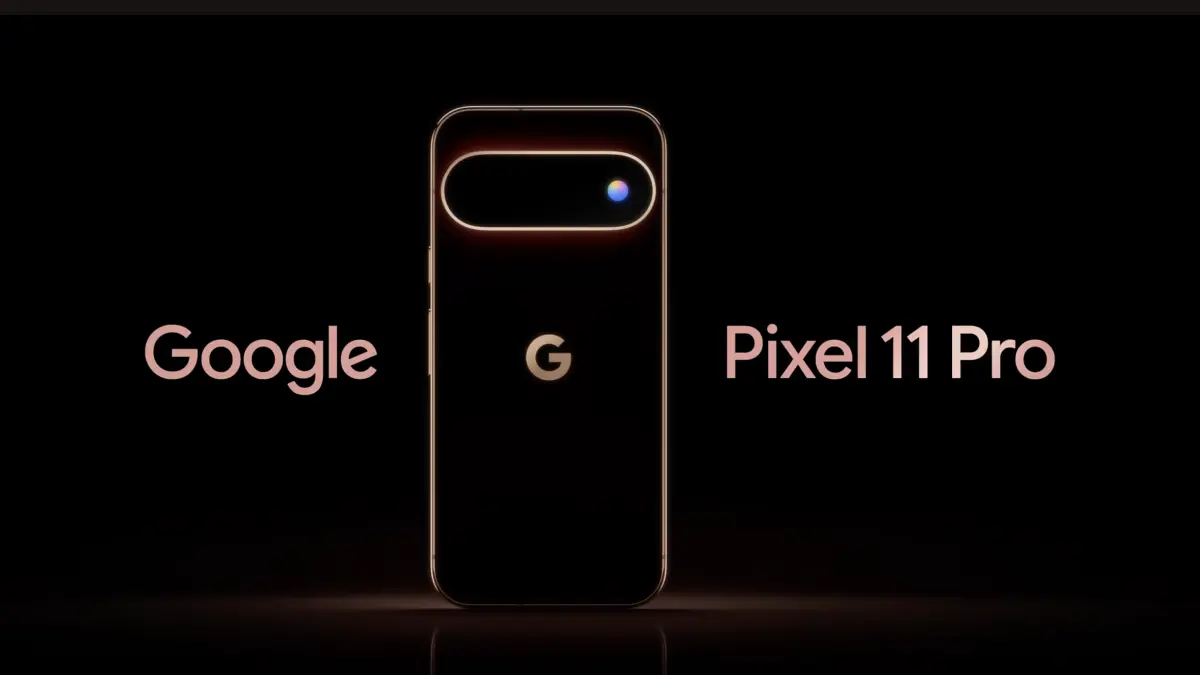
Google has offered the clearest look yet at the Pixel 11 Pro with a short teaser that showcases a new hardware element called the 'glow indicator.' The feature, which appears as a thin luminous strip wrapped around the rear camera bar, lights up in a variety of colors depending on the situation. It is the first time a Pixel flagship has included such a prominent external lighting element, and it suggests that Google is thinking carefully about how phones communicate with users beyond the screen.
What the glow indicator looks like
Based on the teaser, the glow indicator sits directly on the camera bar, which has become a signature Pixel design language since the Pixel 6 series. The strip curves around the outer edge of the raised visor and emits a soft, diffused light. It can flash briefly for notifications, pulse steadily for incoming calls, or change color to reflect different states. The teaser shows the indicator glowing in a pale blue tone when the device is placed face-up on a table, but it also appears briefly in green and amber during transitions. This range suggests that the indicator is not merely decorative; it is designed to convey meaningful information at a glance.
At the back of the phone, the glow indicator is visible only when the phone is face-down or resting on a surface. That may seem like a limitation, but Google has long experimented with ambient awareness. The company's Pixel 4 series featured Motion Sense and radar-based gestures, while later Pixels introduced Always-On Display enhancements. The glow indicator takes this idea in a different direction: instead of requiring the screen to wake, it uses a physical LED element to deliver simple signals. It is low-power, always available, and easy to customize through the Settings app.
How the glow indicator works in daily use
Several use cases are likely at launch. The most obvious is notifications. Incoming messages, emails, and app alerts can be assigned specific colors, allowing you to know whether the notification is urgent without touching the phone. For example, messages from starred contacts could trigger a warm orange glow, while calendar reminders might use a calm white pulse. The camera app could also use the indicator as a privacy safeguard: whenever the front or rear camera is active, the strip could turn a vivid red to signal that recording is in progress. This mirrors the dedicated hardware lights found on laptops and other security-focused devices.
Charging status is another strong candidate. The glow indicator could slowly fade in and out while the phone is charging, then turn a steady green when the battery is full. Some third-party accessories already offer similar functionality, but the Pixel 11 Pro would bring it to the phone itself, with full integration into the operating system. Google Assistant could also take advantage of the hardware. When the user says 'Hey Google,' the indicator might glow in a subtle gradient to indicate that the Assistant is listening, rather than relying on the screen animation alone. That would be especially useful when the phone is across the room or tucked into a dock.
The road to Pixel 11: A brief history
The Pixel lineup has evolved significantly since the original Pixel launched in 2016. The first-generation Pixels concentrated on computational photography and Google software, while the Pixel 6 series introduced the Tensor chip and the camera bar design. The Pixel 8 and Pixel 9 models refined those ideas, and the Pixel 10 series, released in 2025, pushed further with improved low-light photography and longer battery life. Now the Pixel 11 Pro is positioned to be the next major step. The addition of a glow indicator is notable because it is a physical design choice, not just a software update. It signals that Google is willing to add dedicated hardware components to improve the user experience.
In the months leading up to launch, the Pixel 10 Pro has become increasingly common in sales promotions. Deal trackers have noted repeated price drops on Amazon, with discounts of up to $250 and occasional $300 reductions on select colors. That is a typical pattern during the summer before a new flagship unveiling. The Pixel 10 Pro remains an excellent phone, but these discounts have made the upcoming Pixel 11 Pro's potential even more interesting. Buyers who need a phone immediately can save money, while those who can wait may be rewarded with a completely new set of hardware features.
Pixel 11 Pro Fold enters the picture
Adding to the anticipation is a leaked render of the Pixel 11 Pro Fold, reportedly shared on Telegram. That render, which surfaced around mid-July, shows a device with a similar camera bar design but a book-style folding screen. The Pixel 11 Pro Fold is expected to inherit many of the same features as the Pixel 11 Pro, including the Tensor processor and updated camera software. It is unclear whether the Fold will also include the glow indicator, but the placement of the camera bar suggests that the hardware could be shared across both models.
The reveal is said to be about a month away from the leak's date, which places the official announcement in mid-to-late August 2026. This timeline is consistent with Google's recent habit of holding a Made by Google event in August, where the company introduces new Pixel hardware and other devices. The Pixel 11 series will likely include multiple models, and the glow indicator could be one of the differentiating features that encourages users to upgrade.
Why a glow indicator makes sense right now
Smartphone design has reached a plateau. Screens are bright, cameras are advanced, and processors are fast. What remains missing for many users is a lower-stakes way to stay connected. Notifications demand attention through sound and vibration, but the glow indicator offers a quieter, more glanceable alternative. It has practical benefits too. For people with hearing impairments, a visual indicator can be essential for not missing calls or alarms. For those who work in offices or hospitals, a silent light can replace an intrusive ringtone or vibration.
There are also aesthetic advantages. The Pixel camera bar has often been a blank, somewhat monolithic surface. The glow indicator adds life to that area without requiring a full-screen always-on display. It also opens up room for personalization. Users could choose different colors for the contact groups, set breathing effects based on ambient light, or match the indicator to the phone's wallpaper. The Android privacy indicators for camera and microphone already show an orange or green dot at the top of the screen, but the glow indicator extends that concept to the physical back of the phone.
What to expect at the official reveal
Google has not yet commented on the teaser, and it is possible that the final design will change. The 'glow indicator' might be a feature exclusive to the Pro model, or it could appear across the entire Pixel 11 lineup. Software details remain under wraps, but the feature will likely be controlled through a new section in Android's Display settings, with per-app customization. Battery life is expected to remain strong, and the low-power LED should not have a noticeable impact on daily usage.
The official reveal will provide more detail on the glow indicator's exact color options, animation patterns, and available customization. It will also be interesting to see whether third-party app developers are given access to the hardware, allowing apps to trigger the indicator for their own purposes. Some messaging apps could use it to indicate typing status, while gaming apps could use it for special events. The possibilities are broad, and the first full look at the Pixel 11 Pro is only weeks away.
Source: Mashable News