

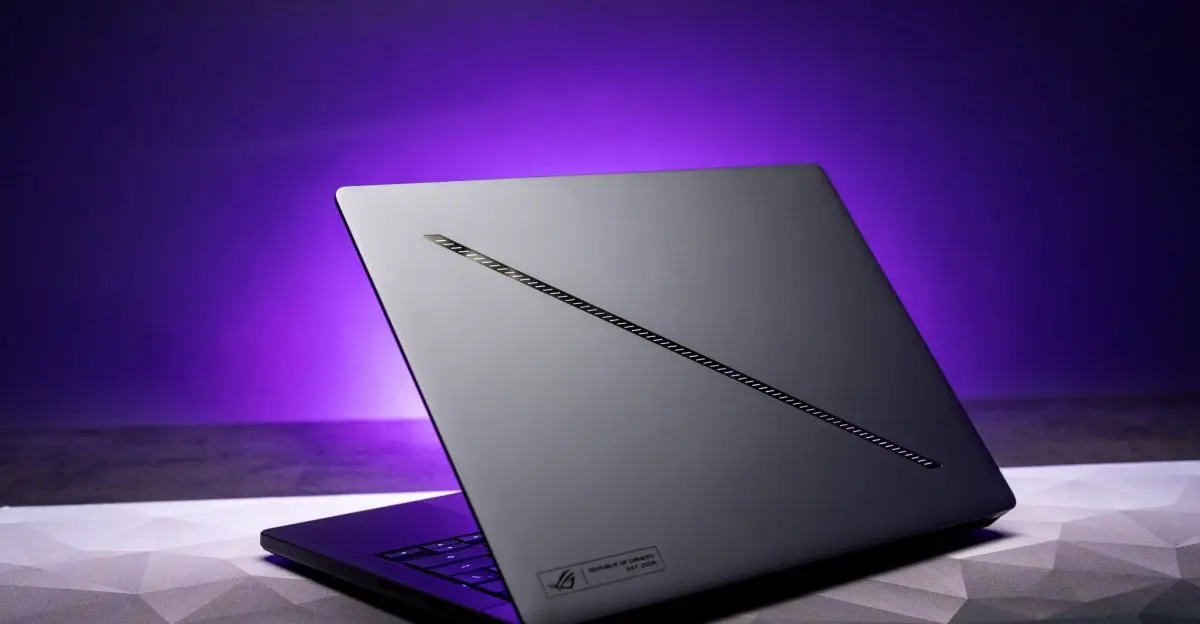
The Asus ROG Zephyrus G14 has been a staple in the gaming laptop market since its debut in 2020. Known for combining portability with powerful hardware, it quickly became a favorite among users who wanted a single device for both work and play. The 2026 model, now powered by Intel's new Panther Lake chips and featuring an Nvidia GeForce RTX 5070 Ti, continues this tradition but arrives with a price that may give many pause.
The new G14 starts at $3,450, with the review config hitting $3,600. That's nearly $1,000 more than a comparable last-gen AMD model, making it one of the most expensive 14-inch gaming laptops on the market. Despite the cost, the device is almost flawless in its design and performance. For someone who demands a laptop that can handle everything from photo editing in Lightroom to AAA gaming at high settings, the G14 is an incredibly compelling choice.
Design and Build
The 2026 Zephyrus G14 retains the sleek, minimalist design introduced in the 2024 redesign. It measures 12.24 x 8.66 x 0.72 inches and weighs just 3.48 pounds, making it comparable in size and weight to the 14-inch MacBook Pro. The lid features an animated slash lighting effect with more LED segments than before, and the bottom cover has circular hole vents instead of rectangular slots. The chassis is made of a sturdy magnesium alloy, and the overall build quality is excellent.
The keyboard and trackpad remain among the best in the Windows laptop world. Keys have deep, tactile travel, and the mechanical trackpad offers a satisfying click. The only downside is that the trackpad doesn't click in all four corners like some competitors, but most users will game with a mouse anyway. The port selection is generous: two USB-C (one Thunderbolt 4), two USB-A, HDMI 2.1, a full-size SD card slot, and a 3.5mm audio jack. The inclusion of a full-size SD slot is a long-awaited upgrade for photographers and videographers.
Display and Audio
The 14-inch OLED panel has a 2880x1800 resolution and a 120Hz refresh rate. It's incredibly bright, hitting 500 nits in SDR and up to 1,100 nits in HDR. Colors are vivid, and blacks are truly deep. This makes it ideal for creative work as well as gaming. The speakers are equally impressive. Asus manages to fit six speakers into this small chassis, delivering rich, full sound with a noticeable stereo stage. It's one of the few Windows laptops that can rival the MacBook Pro for audio quality.
Performance
Under the hood, the G14 is equipped with an Intel Core Ultra 9 386H (16 cores) and an Nvidia GeForce RTX 5070 Ti Laptop GPU (5,888 CUDA cores). The review unit came with 32GB of LPDDR5X RAM and a 1TB NVMe SSD. In benchmarks, the laptop scores well across the board. Geekbench 6 CPU single-core: 2909, multi-core: 17145. Geekbench 6 GPU (OpenCL): 162373. Cinebench 2026 single: 517, multi: 4645. PugetBench for Photoshop: 9941, for Premiere Pro: 10378. Blender classroom test: 294 seconds. The sustained SSD read speed is 6154 MB/s, writes at 5372 MB/s — slightly slower than the previous generation but still very fast.
In real-world use, the G14 feels snappy. Editing hundreds of 50-megapixel RAW photos in Lightroom Classic is smooth, even on battery power. The laptop does get warm under heavy load, but the keyboard deck remains comfortable. Gaming performance is excellent: Battlefield 6 runs at 65-70fps at native resolution with High preset, Helldivers 2 hits 80-90fps, and Marathon stays around 70fps with DLSS on Quality. The Performance profile in Asus' Armoury Crate is the default, but switching to Turbo can boost frame rates by up to 10fps at the cost of louder fan noise.
Battery Life
One of the biggest improvements with the Intel Panther Lake chip is power efficiency. In our battery rundown test, the new G14 lasted over 17 hours, compared to 8.5 hours for the last-gen AMD model. In actual mixed use (browsing, Slack, music streaming), I achieved slightly over 10 hours with the screen at 80% brightness. That's outstanding for a gaming laptop. When using the discrete GPU for intensive tasks, battery life drops to around five to six hours, which is still respectable.
Comparison to Alternatives
The G14's main competition comes from the MacBook Pro 14 (M5), which offers superior CPU performance and even longer battery life. For the same $3,600, you can get an M5 Max model that outperforms the G14 in many productivity tasks, but it can't run many PC games. On the Windows side, the last-gen AMD G14 with equivalent specs is about $1,000 cheaper and still performs well. Larger gaming laptops like the Asus ROG Strix Scar 16 offer higher frame rates and bigger screens but sacrifice portability.
Ultimately, the 2026 ROG Zephyrus G14 is a near-perfect laptop if you need one device for everything. It excels at creative work, gaming, and everyday tasks. But its price is a major barrier. The value that originally made the Zephyrus line so popular has eroded. While the G14 remains an exceptional piece of engineering, it's now a luxury item that many will find hard to justify.
Source: The Verge News