

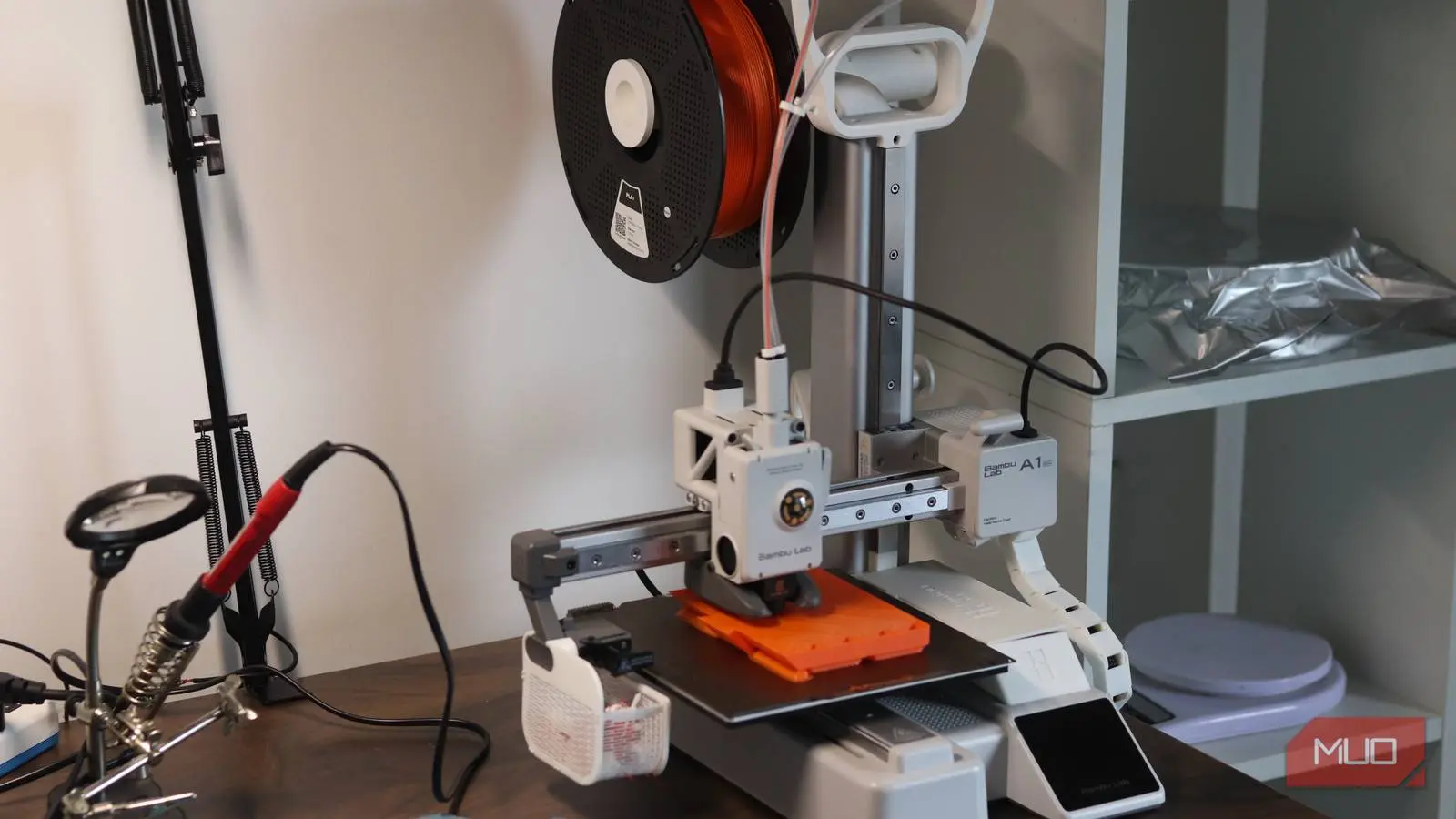
I had prior experience with 3D printing before I first bought one. My first job, straight out of high school, involved repairing and maintaining two 3D printers all the way back in 2017. I fixed those printers, and they ran just fine as long as I was tending to them. They got me hooked on the idea of 3D printing, but they were also the reason I put off buying one for myself for nearly a decade.
When I finally got one in 2026, it turned out I was worrying for nothing. Modern 3D printers have come a long way from their ancestors, and 3D printing is truly approachable for anyone now, not just limited to hobbyists and creators.
The printer was never the problem
I overestimated the noise, space, and disruption a 3D printer would bring
My early experience with 3D printing revolved primarily around the Wanhao Duplicator 3 — a massive, heavy, nearly industrial 3D printer with a relatively small bed but a massive enclosure. I'd slice files on my PC, move them to a microSD card, take it over to the printer, and print only to find that my eyeballed bed-levelling with a sheet of paper wasn't accurate enough. Not to mention the loud noises the printer produced.
I wanted my 3D printer to sit on my electronics workbench, where I work on hardware projects, so size was a real constraint. And since it's right next to my actual work desk, I was worried that constant noise from the printer would be a massive distraction.
When I printed my first Benchy on my Bambu Lab A1 Mini, all of these assumptions vanished faster than I could imagine. The printer has a tiny footprint, looks absolutely gorgeous, and apart from the cooling fan, I can barely hear the motors. Now I run print jobs all day long while working at my desk barely a meter away and hear absolutely nothing.
Speed mattered less than I expected
Long print times stopped feeling important once the printer could work unattended
My time fear had two layers to it. The first was print speed itself. I associated 3D printers with the kind of glacial pace where a small part takes the better part of a day. The A1 Mini dismantled that assumption almost instantly. It prints a standard Benchy test boat in roughly 20 minutes at default speeds, and real-world functional prints like brackets, enclosures, organizers — the kind that make up most of my printing — finish in a fraction of the time older machines would have needed.
The second layer was the amount of attention a print would require from me. Turns out, the answer is almost none. The bed levels itself automatically before every print, filament runout detection pauses the job if you run dry mid-print, and the built-in camera lets you glance at progress from the Bambu Handy app — or if you take the time to set up your printer in Home Assistant — from your integrated smart home dashboard.
I've started printing hundreds of kilometers away from my printer and came back home to a perfect print waiting for me to take it off the print bed. If you maintain your printer and tune your filament right, 3D printing becomes a background process, not a time hog.
Maintenance turned out to be mostly a myth
Modern printers require far less tinkering than their reputation suggests
Beyond print time, I expected ongoing maintenance to quietly eat into my schedule. Back in the day, I considered myself lucky if I was able to get through a whole day of printing without unclogging a nozzle or leveling the bed on the Wanhao Duplicator. Bed calibration, nozzle clogs, belt tension checks — I'd mentally budgeted for all of it as a recurring cost.
In practice, the A1 Mini has asked very little of me. In the 134 hours of total printing time since I've gotten the printer, all I've done is calibrated my filament — and even that wasn't explicitly required, as generic PLA profiles worked well enough with filament from various brands.
The one area where I'd temper expectations is multi-color printing with the AMS or AMS Lite. I didn't get one on account of all the waste it produces, but apart from that, it adds significantly more time and filament to a regular print. But for my everyday prints like custom ESP32 enclosures, mounts, cosmetic parts, replacement brackets, and more, it's been remarkably low friction.
The evolution of 3D printing technology over the past decade has been remarkable. Early printers like the RepRap and MakerBot Replicator required constant calibration and tweaking. Users needed to manually level beds, adjust extruder temperatures, and often deal with warped prints. The software was primitive, with slicing taking minutes and often producing g-code that caused failures. Communities formed around troubleshooting rather than creating. Today's machines incorporate sensors, automatic calibration, and sophisticated firmware that handles most variables. Filament quality has also improved dramatically, with tighter tolerances and consistent diameter, reducing clogging and under-extrusion.
Another critical advancement is in print bed adhesion technology. Early printers relied on blue tape or glue sticks. Modern printers use PEI sheets, textured glass, or flexible steel plates with built-in magnets. The Bambu Lab A1 Mini uses a dual-sided PEI-coated plate that provides excellent adhesion when hot and releases prints easily once cooled. This eliminates one of the most frustrating aspects of early 3D printing: prints popping off mid-job or adhering so strongly they require a chisel to remove.
The software ecosystem has also matured. Slicers like Bambu Studio, PrusaSlicer, and Cura now offer pre-configured profiles for specific printers and filaments. They include features like variable layer height, adaptive infill, and tree supports that dramatically improve success rates. Cloud connectivity allows monitoring and control from anywhere. Mobile apps provide notifications when prints complete or encounter issues. This shift from hobbyist tinkering to appliance-like reliability is the single biggest change in the industry.
The biggest mistake was waiting so long
I should have bought a 3D printer years earlier instead of overthinking it
I got my printer before Bambu Lab pulled the HP playbook on 3D printing; regardless, they do make a mean printer. Even modern printers from the likes of Creality, Elegoo, and Prusa now behave more like a hobbyist tool and more like a home appliance. You configure it once, make a few adjustments to the defaults (or trust them), and it just works. The printer doesn't ask for entire days of maintenance, it doesn't magically fail out of nowhere, and with basic maintenance like cleaning the build plate or lubing the rails, it works just fine.
I was holding on to a mental image of 3D printing from nearly a decade ago and hadn't updated it. If your hesitation, like mine, was really about time — both the time prints take and the time and skill the machine demands of you — 3D printing has addressed both sides of that equation. It's fast, reliable, and it gets out of your way. I wish I had stopped waiting much sooner.
For anyone considering entering the 3D printing world today, the barriers have never been lower. Entry-level printers that perform remarkably well can be had for under $300. The A1 Mini itself is priced competitively, and even enclosed models like the Bambu Lab P1S or Creality K1 offer plug-and-play experiences. Filament is cheap, with PLA costing around $20 per kilogram. Online repositories like Printables, Thingiverse, and MakerWorld provide millions of free designs, from practical household items to artistic models. The learning curve has flattened dramatically; you can unbox a printer, run automatic calibration, and print a useful object within an hour.
Moreover, the community has evolved from a niche of enthusiasts to a diverse ecosystem of makers, educators, and businesses. YouTube channels, forums, and subreddits offer troubleshooting help and inspiration. The technology is being used for prosthetics, custom tools, architectural models, and even food-safe items (with proper materials). The environmental impact is also worth noting: 3D printing enables on-demand manufacturing, reducing waste from mass production and shipping, while PLA is biodegradable under industrial conditions.
My personal journey from skeptic to advocate has taught me that sometimes the best move is to just start. The fears I harbored were grounded in an outdated reality. Modern 3D printing is not the finicky, noisy, slow process I remembered. It is a quiet, fast, and reliable tool that integrates seamlessly into a busy workflow. Whether you are a hobbyist, an engineer, or just someone who likes to fix things around the house, a 3D printer can be an invaluable addition to your toolkit. The only question is why you haven't bought one yet.
Source: MakeUseOf News