

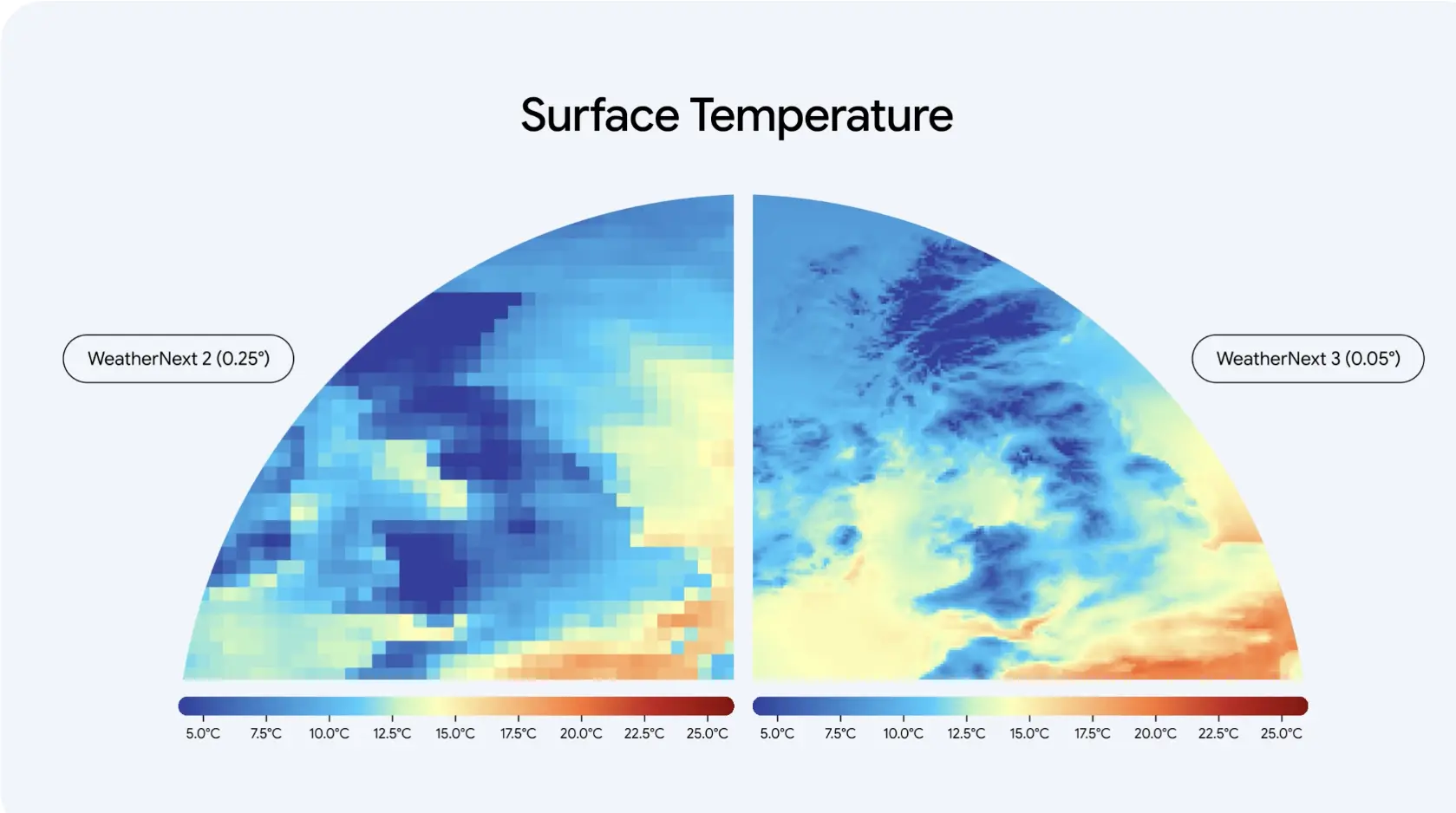
Google is moving its artificial intelligence weather technology deeper into the energy sector. The company has begun targeting grid operators with WeatherNext 3, a forecasting system designed to help utilities, renewable developers, and system planners anticipate changing atmospheric conditions. The move signals one of the most direct attempts by a major technology company to sell AI weather prediction tools to the electricity industry.
Why grid operators are paying attention
Operating an electricity grid has become significantly harder as coal and gas plants are replaced by solar panels and wind turbines. Unlike thermal power plants, which can be ramped up or down on demand, wind and solar generation depends on when the wind blows and when the sun shines. That makes accurate weather information a core business requirement rather than a useful extra.
Grid operators must continuously balance supply and demand. If a forecast is wrong on the low side for solar generation, they may have to purchase expensive reserve power or ask customers to reduce consumption. If a forecast is wrong on the high side, they may need to curtail renewable generation and waste cheap, clean electricity. With higher renewable penetration, these balancing decisions occur more frequently and with less warning.
Traditional numerical weather prediction models require enormous supercomputers and still take hours to run. They divide the atmosphere into three-dimensional grids and solve physical equations to simulate how weather systems evolve. Millions of calculations are completed before a forecast is delivered. While these models are reliable, they are expensive and not always fast enough to support trading and operations in fast-moving energy markets.
What WeatherNext 3 brings to the energy market
WeatherNext 3 is designed as an alternative for users who need high-resolution, regularly updated forecasts. Rather than solving the laws of physics from scratch, an AI weather model learns patterns from decades of historical atmospheric observations and reanalysis data. Once trained, it can generate a forecast in seconds or minutes, which makes it possible to update predictions more frequently and produce a larger set of possible outcomes.
This approach is particularly suited for the energy industry because market participants rarely need just one scenario. A utility trying to rebuild a storm-damaged network needs to know the likely path and strength of a hurricane. A wind farm operator bidding into a daily power auction needs to quantify the risk that wind speeds will be lower than expected. A solar trader wants to know how cloud cover will develop if changing atmospheric conditions are uncertain.
Probabilistic forecasts provide that kind of information. WeatherNext 3 produces probability distributions rather than single-value forecasts, allowing grid operators to make decisions that balance risk and cost. For example, it can show that there is a 60 percent chance that wind generation will exceed a certain threshold at a specific hour, alongside a 20 percent chance that it will fall below another threshold. Grid operators can then decide how much reserve capacity to keep available.
From research model to commercial product
Google has been developing AI weather models for several years. The modeling team focused on graph neural networks, which treat the atmosphere as a series of connected nodes and allow weather patterns to propagate across distances more efficiently than some traditional frameworks. WeatherNext 3 is part of that line of research, but it is aimed less at academic weather enthusiasts and more at enterprise customers.
The push into the energy market is logical. Energy is among the most forecast-dependent industries, and trading desks already spend large sums on weather consulting and data services. A machine learning model that can improve forecasts for wind, solar, temperature, and precipitation could save utilities millions of dollars through better scheduling, lower reserve costs, and reduced penalties in power markets.
Grid operators also need to anticipate extreme events. Cold snaps, heat waves, droughts, and storms are becoming more frequent and more intense. A forecast that underestimates peak electricity demand during a heat wave can trigger blackouts. An AI system that flags an unusual temperature pattern earlier may give operators time to call up emergency generators, secure additional power imports, or launch demand-response programs.
WeatherNext 3, like other modern AI models, uses a technique called autoregressive forecasting. After being trained on historical data, the model generates a prediction for one time step and then feeds that prediction back into itself to generate the next step. This process continues until it produces a forecast for the desired horizon. The output can include variables such as wind speed at different altitudes, temperature at the surface and upper levels, precipitation, and atmospheric pressure. Those variables are essential for calculating the output of wind turbines and solar panels.
A fast-growing competitive field
Google is not alone in this space. European weather centers have opened their data libraries to AI researchers, and several private companies are rolling out weather models based on foundation-model technology. These systems use self-supervised learning and massive parameter sets to take a more flexible approach to atmospheric modeling. Some are marketed to insurers, logistics providers, and agriculture companies as well as energy firms.
For Google, entering the energy market means competing on more than just forecast speed. Grid operators and trading firms will want the model to provide a long enough forecast horizon to support operational planning. Many weather models now produce forecasts of up to 10 days with reasonable skill, and some can run ensemble forecasts that cover many possible weather paths.
There is also a question of access. If a grid operator relies exclusively on a commercial AI model, it may become dependent on data from outside the organization. That is why many utilities prefer to test new models against their own historical records and in-house forecasts before integrating them into critical systems. Google may need to offer not only the model itself but also interfaces that allow grid operators to connect it to their SCADA systems, energy management software, and market platforms.
Capturing value from renewable forecasting
The biggest payoff from AI weather forecasting is probably in renewable energy integration. In many regions, wind and solar now make up a large share of generation capacity. California, Texas, Germany, and Spain have days when renewables exceed demand, but they also have days when output falls sharply. Forecasting those drops is one of the most important ways to make renewable grids stable.
WeatherNext 3 could help solar plant operators anticipate the movement of cloudy systems and help wind farm operators identify periods of high wind speed that support the safe operation of turbines. Better forecasts also allow operators to plan maintenance around weather. If a model predicts calm conditions for the next 24 hours, a wind farm can take a turbine offline for lubrication or blade inspection without worrying about losing generation.
In power markets, the spread between forecasted renewable output and actual output can have direct financial consequences. Many countries impose imbalance charges when a generator fails to deliver the power it committed to sell. An improved forecast cuts the risk of imbalance by giving the trading desk more confidence in its offer. Even a one-percentage-point improvement in forecast accuracy can be worth millions of dollars across a large portfolio of plants.
Challenges and limitations
AI weather forecasting is not a perfect replacement for physics-based modeling. Machine learning models are trained on data from the past, and weather patterns are evolving because of climate change. If a formerly rare event becomes common, a model may not handle it well. Training data errors can also be absorbed and reproduced by
Source: AI News News