

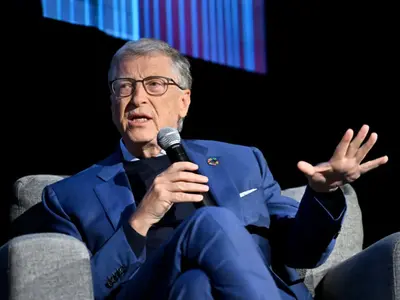
Bill Gates, the co-founder of Microsoft and a renowned philanthropist, has long been a visionary in the technology sector. His predictions about the future of computing have proven remarkably accurate over the decades. Now, Gates is turning his attention to the impact of artificial intelligence on the workforce. In recent interviews and public statements, he has warned that AI will eliminate many jobs, but he also believes that three specific careers will not only survive but thrive in the age of automation.
Gates' perspective is grounded in his deep understanding of technology and economics. He has been involved in the tech industry since the early days of personal computing and has observed how automation and software have transformed industries. He argues that while AI can perform routine tasks and analyze vast amounts of data, it lacks the human qualities of creativity, strategic thinking, and ethical judgment. These qualities are essential in the three fields he identifies: coding, energy expertise, and biology.
1. Coders – The Architects of AI
It may seem ironic that the people who build AI are considered safe from its disruptive effects, but Gates explains that AI still requires human oversight. "AI can generate code, but it is far from perfect," he notes. "It can produce functional scripts, but it struggles with debugging, optimization, and understanding complex business logic." In essence, AI is like a talented but inexperienced assistant; it can draft solutions, but a senior coder must review and refine the output.
The demand for software engineers, AI specialists, and data scientists is likely to increase as AI becomes more pervasive. Companies will need professionals who can design, train, and maintain AI systems. Furthermore, ethical and security considerations require human judgment. For example, AI can inadvertently introduce biases or vulnerabilities into code, and only human experts can identify and mitigate these risks. Gates emphasizes that coders who evolve their skills to work alongside AI will have a competitive advantage. The key is to focus on high-level architecture, creativity, and problem-solving rather than repetitive coding tasks that AI can handle.
2. Energy Experts – The Stewards of Power
The energy sector is another domain where human expertise remains irreplaceable. Managing the global energy supply involves navigating complex geopolitical, economic, and environmental factors. Gates points out that AI can optimize grid operations and analyze consumption patterns, but it cannot make strategic decisions about energy policy, infrastructure investments, or crisis response.
Consider the challenge of transitioning from fossil fuels to renewable energy sources. This shift requires not only technical knowledge but also political acumen, public engagement, and long-term planning. Energy experts must assess the feasibility of new technologies, such as nuclear fusion or advanced battery storage, and determine how to integrate them into existing systems. AI can provide data, but human leaders must weigh trade-offs and make decisions that affect millions of people.
Gates highlights the importance of energy in combating climate change. He has invested heavily in clean energy research through his organization. He believes that biologists and engineers working on new energy solutions will be in high demand. The world will always need people to keep the lights on—both literally and figuratively.
3. Biologists – The Explorers of Life
Biology is perhaps the most surprising entry on Gates' list. While AI has made strides in tasks like diagnosing diseases from medical images or predicting protein structures, Gates argues that genuine scientific discovery remains a human endeavor. "Innovation requires creativity, critical thinking, and real-world experimentation," he states. "These are things that cannot be programmed into an algorithm."
Biologists and medical researchers ask fundamental questions about how life works. They design experiments, interpret unexpected results, and make leaps of intuition that AI cannot replicate. For example, the development of mRNA vaccines for COVID-19 was a breakthrough that required years of human ingenuity. AI tools helped accelerate some analyses, but the core insights came from scientists who understood the underlying biology.
Gates also notes that AI is only as good as the data it is trained on. In biology, many phenomena are poorly understood, and data sets are often incomplete or biased. Human experts must collect new data, validate findings, and ensure that conclusions are robust. As AI becomes more powerful, it will augment the work of biologists, but it will not replace them. The field will continue to demand curious minds willing to explore the unknown.
The Broader Implications of AI on the Workforce
Gates' predictions are part of a larger conversation about automation and employment. He compares the current AI revolution to the Industrial Revolution and the rise of the internet. Both transformations displaced many workers but also created new opportunities for those who adapted. The key, Gates argues, is education and lifelong learning. Workers must be prepared to upgrade their skills continuously.
He also acknowledges that his predictions could be wrong. AI may evolve faster than expected, or unforeseen breakthroughs might render some jobs obsolete. However, the three fields he identifies are grounded in human attributes that are difficult to automate: complex problem-solving, ethical judgment, and creative discovery. Even if AI becomes more advanced, it will likely serve as a tool rather than a replacement for these professionals.
For individuals considering career paths, Gates' advice is clear: develop expertise in areas where AI complements human skills rather than replaces them. For example, a junior programmer who learns to collaborate with AI coding assistants will be more valuable than one who ignores the technology. Similarly, an energy analyst who understands both AI and energy markets will have an edge over a pure data scientist.
The article also touches on the importance of AI in developing countries and how access to technology can level the playing field. However, Gates cautions that if AI is not managed carefully, it could exacerbate inequality. He advocates for policies that ensure the benefits of automation are widely shared, such as retraining programs and social safety nets.
In the end, Gates remains optimistic about the future. He believes that AI will solve many of the world's most pressing problems, from disease to climate change, but only if guided by human wisdom. The three careers he highlights—coding, energy expertise, and biology—embody the blend of technical skill and human insight that will define the next era of innovation.
Source: ECR News